How I started keeping an art journal without being an artist
My art journal is objectively bad. The proportions are wrong, the colours are muddy, and the perspective is pure chaos. I open it almost every day.
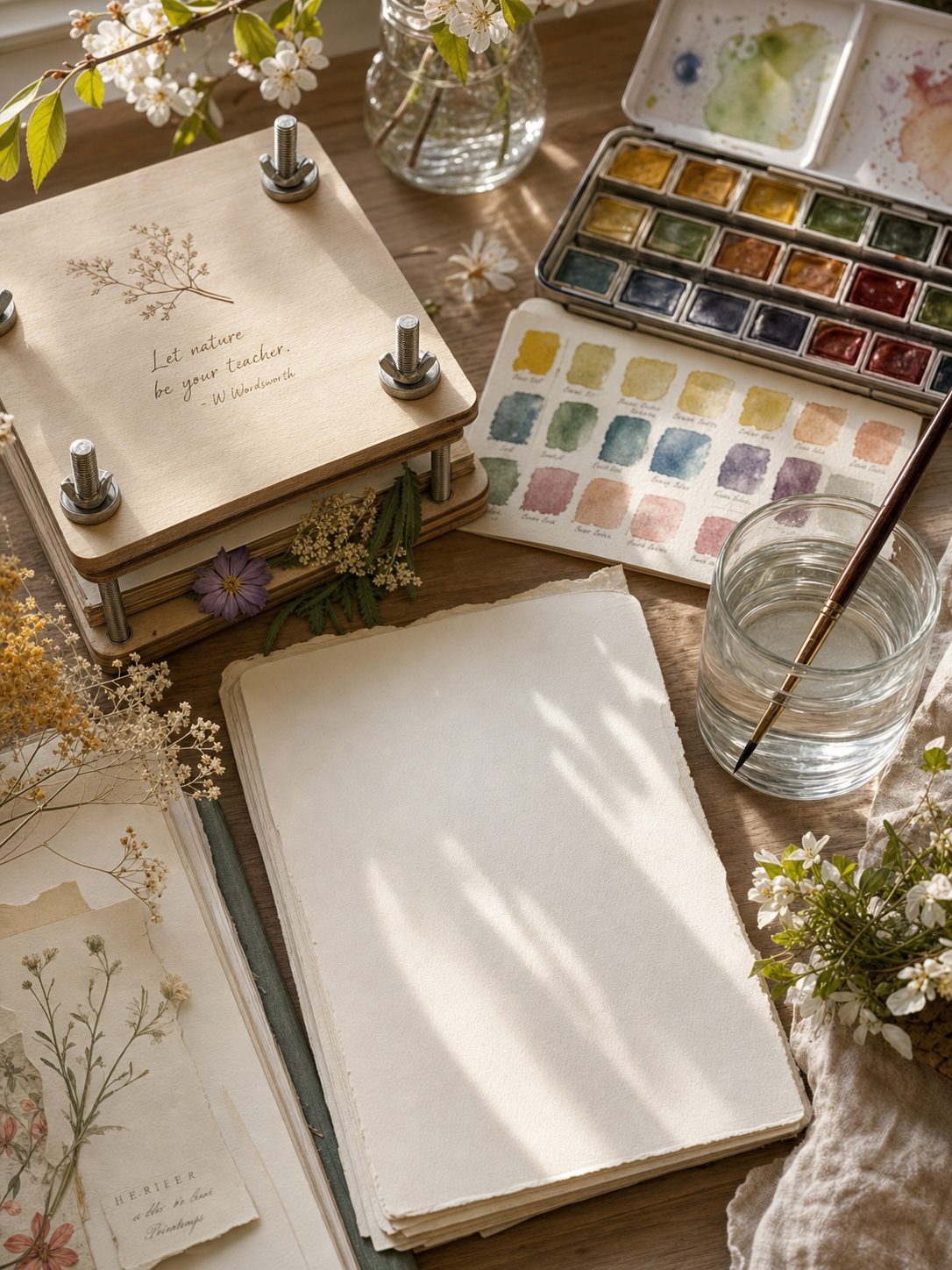
My art journal is objectively bad. I have looked at it with enough honesty to be clear on this. The proportions are wrong, cups look like ovals with handles, faces look like anxious moons. The colours are often muddy because I mix everything into a sort of universally brownish grey when I'm not paying attention. My perspective is pure chaos, nothing sits at the right angle, and my handwriting when I add text is illegible enough that I sometimes can't read what I wrote two weeks later.
I open it almost every day.
This is the thing I want to write about, not how to make good art (I can't tell you, I don't know), but what it's like to keep a creative practice that isn't trying to produce anything impressive. What happens when you make things that are only for you, that exist in no metric, that don't need to justify themselves to anyone, including yourself.
What stopped me for years
I was convinced you needed talent to begin. Not just ability, talent, the capital-T version, the innate thing, the thing you either had or didn't. I had internalised the idea that making visual art without being naturally good at it was a kind of pretence. That the sketchbooks were for people who could draw, the watercolours were for people who had taken actual lessons, and that attempting either without the right credentials was like showing up to a performance when you hadn't auditioned.
I don't know exactly where I got this belief. Probably school, where art was a subject with grades, and my grades were solidly mediocre, and mediocre felt like a verdict on whether I was allowed to continue rather than just a reflection of where I was that particular year. By the time I was an adult I'd absorbed it so completely that I didn't even argue with it, I just didn't paint. For years.
I pressed flowers instead. I wrote in my paper journal. I found ways to make things that felt safer because the stakes felt lower, prose is more forgiving than a painting, somehow. Flowers already look like themselves. Nothing I do to them is irreversible. Putting colour on paper felt different. More exposing. More likely to produce evidence of my limitations.
What finally shifted me was a phrase I kept encountering, usually in the art-drawing and journaling corners of the internet, about process versus product. The idea that making things isn't only about what you end up with, that the act of making, the physical meditative doing of it, has value that has nothing to do with whether the result is good. I'd read this probably a dozen times before it lodged. The twelfth time, for some reason, I went to the shop and bought a blank notebook and three tubes of watercolour.
The starter kit, very deliberately simple
A blank notebook. Not a proper watercolour paper pad, I was very conscious that buying expensive materials would raise the stakes and I needed the stakes to be low. A standard blank notebook with slightly heavier paper than usual, around A5, nothing intimidating about it. Three tubes of watercolour: a warm red, a blue, and yellow. That's enough to mix the colours you actually need. One brush, medium-sized, rounded, from the budget range. Total outlay under fifteen pounds.
I did not buy a "how to" book. I did not watch a tutorial before starting. I wanted to begin from not knowing anything, deliberately, because I didn't want the inner critic to have any performance standard to measure me against. No tutorial means you can't do it wrong relative to the tutorial. You're just making marks. That was the only thing the first session was supposed to be: making marks.
The first page was a colour test. Just swatches. Blobs of each colour, then blobs of them mixed. Then water added to see what happened. Fifteen minutes. Nothing that would count as art by any stretch. But I'd opened the thing, and I'd put paint on paper, and there was a small sense of permission having been granted that was more significant than the page deserved.
What I actually do in it now
It's been three months. The journal is about a third full. Here is an honest catalogue of what's in it: loose colour experiments where I was trying to see what happened when two colours met wet on wet. A very bad sketch of my mug, recognisable only because I labelled it "my mug." Two pressed flowers taped to pages with a line or two written next to them. A page that is just grey wash because I was sad one afternoon and didn't want to do anything except sit with colour for a bit. Several illegible passages of writing in my worst handwriting. A better-than-expected painting of the view from my window at dusk, which I was so surprised by that I photographed it before I could question it. More colour swatches. A page of marks I made while listening to music and trying to draw what the song sounded like, which produced something that looks like a seismograph reading but which I can look at now and hear the song.
None of this would constitute a portfolio. All of it has value to me in a way that's entirely personal and entirely unjustifiable to anyone else. That's exactly the point.
The rainy afternoon scene, what it actually feels like
Last week, mid-October, rain on the window, that specific October rain that sounds like the year is trying to say something, and I had nothing scheduled in the afternoon for once and I sat down with the journal and the watercolours and spent about forty minutes just painting. No plan. No reference. I started with a wash of blue and let it go where it went, which was across the whole page, which I let dry, and then I came back with a darker blue and the edge where the wet pigment met the damp page made these soft, unexpected blooms, that thing watercolour does when you let it lead rather than forcing it.
I mixed in some of the red. It went slightly purple in some areas and slightly orange in others and I watched it happen with something close to wonder. Not my wonder at my own skill, I had no skill in this moment, but wonder at the behaviour of the materials, at the fact that paint and water do things you didn't plan and those things are often more interesting than what you would have planned.
There was a complete absence of judgement. Not because I'd trained myself out of it, but because there was genuinely nothing to judge. No one would see this page. It didn't need to be good. The question of whether it was good was simply not in the room. What was in the room was the smell of the paint, faintly metallic; the sound of the rain; the quality of light through the window, grey and flat and oddly beautiful; the sensation of the brush moving through water and colour; and a sense of total presentness that I rarely achieve any other way.
That's what the art journal is. That's what it's actually for.
What the practice is about, the real thing
You are allowed to make things that are only for you. Things that exist in no metric, that don't need to be good, that belong entirely to the making of them.
I've thought a lot about why this feels so different from other things I make. And I think it's because everything else I make, the videos, the writing, exists in some degree of relationship with an audience, even when I'm telling myself it doesn't. There's always a background awareness of how something might be received. I can't fully turn that off. It's part of the texture of being a person who makes things for other people.
The art journal is genuinely not for anyone. It has no audience. It can't be shared in a way that would make sense, the pages are too private, too crude, too much evidence of the process rather than a result. It exists only in the making of it. And that means, for the duration of the making, I am not a creator. I'm not a person trying to communicate anything. I'm just a person moving a brush through colour, watching what happens, making marks that belong to no one but me.
The meditation of it isn't metaphorical. The focus required to follow a line of paint, the kind of gentle, absorbed attention it takes to mix a colour you're trying to find, these are genuinely meditative states, the kind where the chatter quiets and you're just here, just doing this one thing, fully. I don't get that from my paper journal, which is all words and thoughts. I get it from the art journal, which is colour and accident and permission to make something bad.
You're allowed to make things that are only for you. You don't need to be good at them. You don't need to justify them. You don't need a talent for them. You need a blank notebook, something to put colour with, and the willingness to begin badly and stay with it anyway. The rest, the quiet, the presence, the strange small satisfaction of a page that didn't ask permission to exist, follows on its own.