The autumn outfit formula I'm living in right now
I spent years buying autumnal clothes that didn't work together. This year I found three anchor pieces and everything simplified.
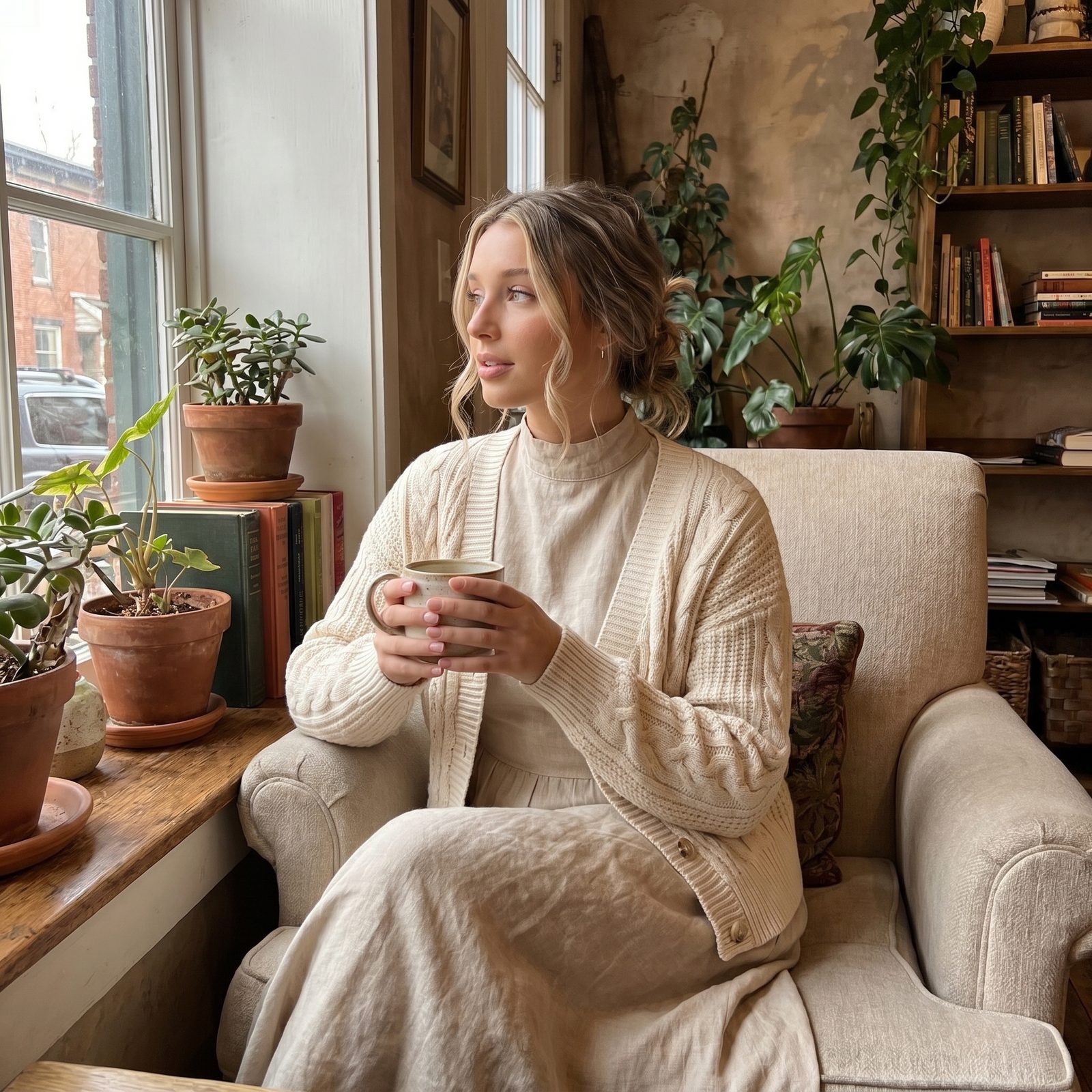
There's a particular kind of getting-dressed experience that I spent most of my twenties having and didn't have a name for until recently. It goes like this: you open the wardrobe. You have a lot of clothes. You try several things on in sequence, each one slightly wrong for reasons you can't fully articulate. You run out of time. You leave in something you don't feel good in and spend the rest of the day mildly annoyed with yourself. Not a disaster. Just a daily low-level friction that accumulates into a quiet, persistent sense of not quite being at home in your own clothes.
The clothes aren't bad. They're just not a wardrobe, they're a collection. Assembled one item at a time in response to moods and sales and "this is nice but where would I even wear it" impulses, without any coherent underlying logic. And so nothing quite goes with anything else, and every morning is a small negotiation with yourself that you kind of lose, and then you go about your day having started it slightly off.
This autumn has been different. And the difference came from three anchor pieces that I've been living in for six weeks now and still reach for every time.
The three pieces I keep reaching for
First: a chunky cream cardigan. Oversized, soft, the kind that holds its shape and gets better with every wear. I've had versions of this cardigan in past years but they've always been slightly wrong in ways that were hard to name, too thin, too formal in their construction, too prone to pilling after three washes, slightly the wrong shade of white that looks deliberate in the shop and wrong at home. This one is right. It hangs properly. It's warm without being heavy. It works as a layer over almost anything or as the main event on days when I want comfort to be the whole outfit.
Second: wide-leg trousers in camel. I resisted these for longer than I should have because the silhouette felt unfamiliar. There's something about wide-leg trousers that seems like it requires a specific kind of confidence or a specific kind of body or just a kind of casual ease I wasn't sure I had. Unfamiliar doesn't mean wrong, I know this, I believe this, and I still needed time with this particular truth. When I finally tried them on and moved around in them rather than just standing still in a changing room, I understood immediately. The volume of the leg is what makes them work. They move with you. They're the opposite of restrictive. They make you feel like you have slightly more space than usual, which is a good feeling to start a day with.
Third: a pair of ankle boots I've had for three years. Dark leather, slightly worn in, comfortable enough now that I forget I'm wearing them within ten minutes of putting them on. The leather has softened to the point of memory, they know the shape of my feet and have adjusted accordingly. These are the kind of shoes that have earned their place in a wardrobe not by being impressive but by being completely reliable every single time. No blisters. No regrets. No evenings where I took them off the moment I came home. Just three years of turning up.
Those are the three. From those three pieces, in rotation with a handful of simple underneath layers, nothing fancy, I have an autumn wardrobe that makes getting dressed feel like something I look forward to rather than something I negotiate. That shift in the morning experience, small as it sounds, has changed the start of quite a few days.
The formula: anchor, comfort, intention
The cozy fits logic I've landed on is deceptively simple. For any autumn outfit I'm happy with, I can trace three elements: an anchor piece (the main visual statement, usually the cardigan on its own, or the trousers when I want to build up from the bottom), a comfort layer (something worn close to the body that provides warmth and ease without demanding attention), and one thing that feels intentional. That third element is the one that makes an outfit feel chosen rather than just assembled.
The intentional thing changes. Sometimes it's the earrings, something a bit more considered than my usual, the ones I'd normally save for going out. Sometimes it's the particular shirt I've chosen to put under the cardigan and whether I've left it untucked or half-tucked. Sometimes it's just that I've added a thin belt to the trousers, or chosen the bag with the interesting clasp rather than the everyday one. The intentional thing is always small. That's the point. Something small and deliberate does the same work as a much larger, more complicated outfit, it signals that you made a choice, and the signal is what you carry into the day.
The formula works because it removes decision from most of the outfit and reserves decision for one thing. That one thing is more pleasurable to think about than the whole-outfit negotiation I used to do. It feels like playing rather than problem-solving. I spend about ninety seconds on it and I come out of the wardrobe ready, which hasn't always been true.
How I make them feel different day to day
This is the part I'm most pleased about, because it answers the capsule wardrobe objection I always had: won't I look the same every day? Won't people notice? Won't I get bored?
The answer, experience has confirmed, is almost entirely no. For reasons that feel disproportionate to their simplicity.
The shirt under the cardigan does most of the work. A white one reads clean and intentional, slightly put-together. An oatmeal-coloured one reads softer and more layered, like I've thought less about it even though I haven't. The striped one I found at the back of my wardrobe from three years ago, barely worn because I couldn't make it work before, turns out to be the perfect underneath layer for this specific cardigan combination, and I feel mildly triumphant about this every time I wear it.
Hair is the other significant variable. Up and pinned back and the whole outfit feels more deliberate, more intentional. Down and wavy and it softens everything, makes it feel more like a slow day. Half-up, my default for most mornings, splits the difference in a way I find endlessly useful.
The bag changes the whole tone. The structured small one and the outfit feels more put-together, more like I'm going somewhere that matters. The soft canvas tote and it looks effortless. The battered backpack I've had since what feels like a previous life makes me look like a person who doesn't care very much, and somehow this also works with the cardigan and trousers, which I wasn't expecting but I'm not questioning.
I've worn essentially the same building blocks for six weeks. I haven't looked the same twice. The formula creates a context; what you bring to it each day changes the meaning.
The first truly cold November morning
Last week. The morning where the temperature shift was not a slight adjustment but a signal, the kind of cold that arrives fully committed, autumn becoming something more serious, something asking for proper response rather than layering in a mild, optimistic way.
I woke up to it before I opened my eyes. The quality of the silence had changed overnight. A flat in real November cold sounds differently still than a flat in October, there's a quality to it, a heaviness, like the air itself has slowed down. Outside the window the trees had given up most of their colour and were doing their winter architecture, honest and bare and beautiful in the way that stark things can be.
I got up and went immediately for the cardigan. Not as a choice, as a reflex. The thick one, the cream one, the one that lives on the chair by the window now rather than in the wardrobe because it's worn too often to warrant the journey. I pulled it on over what I'd slept in and stood at the window with my mug of tea, the dark-berry blend I switch to in November, earthy and slightly smoky and warm in a way that feels correct for the season, and I just stood there for a few minutes watching the grey street.
The physical pleasure of that moment was simple and complete. The cardigan soft and warm. The mug in both hands. The window cold against the glass on the other side, and the flat warm on this side. My particular corner of the world doing its November thing quietly outside while I was in here, warm and unhurried, in the right clothes for the morning.
I thought: this is what I was building. Not just an outfit. A feeling that I can reliably access. A physical way of meeting the harder months gently.
What I'm waiting for, and why I'm making myself wait
There's a coat. There has been a coat in my imagination for a while, long, charcoal or dark grey, structured at the shoulders and easy everywhere else, the kind that looks correct walking across wet cobblestones in low evening light in November. I know the shape. I've found several that are close. I haven't bought any of them.
Not because I can't. Because I've learned something this autumn about waiting for exactly right versus settling for close. The cream cardigan took three attempts over two years. The camel trousers required trying on the wrong ones first. Both times I was glad I waited, and both times the satisfaction when I found the right version was significantly greater than it would have been for a near-miss.
There's a patience available to me around clothes that I've been developing, a willingness to let the thing I actually want exist in my mind for a while without immediately filling the space with the nearest available approximation. I think this is the real glow up. Not the coat itself. The ability to wait for it. The knowledge that the wardrobe you actually want is worth the patience it takes to build.
A capsule isn't about having less, it's about having exactly right. And exactly right is worth waiting for, even when close is readily available.
Three pieces, six weeks, no getting-dressed friction. November feels very manageable from inside a cream cardigan. I'll report back on the coat when I find it.