Behind the edit: what my content looks like before it's pretty
I think there's a dangerous implication in polished content that it came out that way. Mine absolutely does not. Here's what the editing process actually looks like.
Something I want to address directly, because it's been sitting in the back of my mind since I started posting more regularly: the implication that exists inside a polished piece of content. The implication that it came out that way. That there exists somewhere a version of this person who sets up a camera, says the thing once, looks correctly into the lens at the right angle, and is done by 10am.
Let me be clear: that is not me. It has never been me. And I suspect it is not most people, and the silence on the subject has consequences, for newer creators especially, who watch something finished and tidy and conclude that they must be doing it wrong because their process looks nothing like the result. The result never looks like the process. That's what editing is for.
Here is what the editing process actually looks like in my small flat, on my ordinary laptop, at hours that vary but are more often later than I'd planned.
The raw footage situation
The raw files are not clean. They are not close to clean. They are the digital equivalent of a room before you tidy it, every version of an idea in slightly different form, the good takes sandwiched between the bad ones, with no labels and no apparent system and a naming convention that my future self will find baffling.
There's the bad-light take. This is the one from the window-facing setup where I looked into the camera like someone who had never seen a camera before, and the light changed halfway through because a cloud moved and now one half of the clip is brighter than the other in a way that cannot be corrected without it looking corrected. Into the bin.
There's the wrong-angle take. This happens more often than I like to admit: I watch a clip back and the camera was just fractionally lower than intended and so the whole thing has a slightly ominous quality, like I'm being filmed by someone standing in a hole. The story itself might be exactly right but the shot is wrong and you can't fix the shot in post, not really. So: redo, different day, better placement.
There are the three takes where I started laughing. Sometimes this is at something I said that struck me as unexpectedly funny when I heard it back from the other side. Sometimes it's at the sheer peculiarity of the act, sitting alone in a room talking earnestly at a small black rectangle about my feelings, which, when you look at it from a certain angle, is genuinely absurd. The laughing takes go in the bin but I'm always fond of them. They're the evidence that I was having a genuine human moment rather than executing a performance task.
There's the take where I clearly forgot what I was going to say about a third of the way through and my eyes went to the middle distance in a very specific way that I now recognise, having watched it back too many times, as: she's lost it. Ten seconds of Sophia staring into the lower left corner trying to retrieve a sentence she can feel getting away from her. I've learned to stay still on camera when this happens and wait, which is better than the visible searching I used to do. Sometimes the sentence comes back. Sometimes it doesn't. In the edit I can usually cut it or cover it with a different shot, but in the moment it feels very long indeed.
The editing is where all of this gets managed. The camera just collected material. Now comes the actual work: finding what's in there.
My actual editing setup
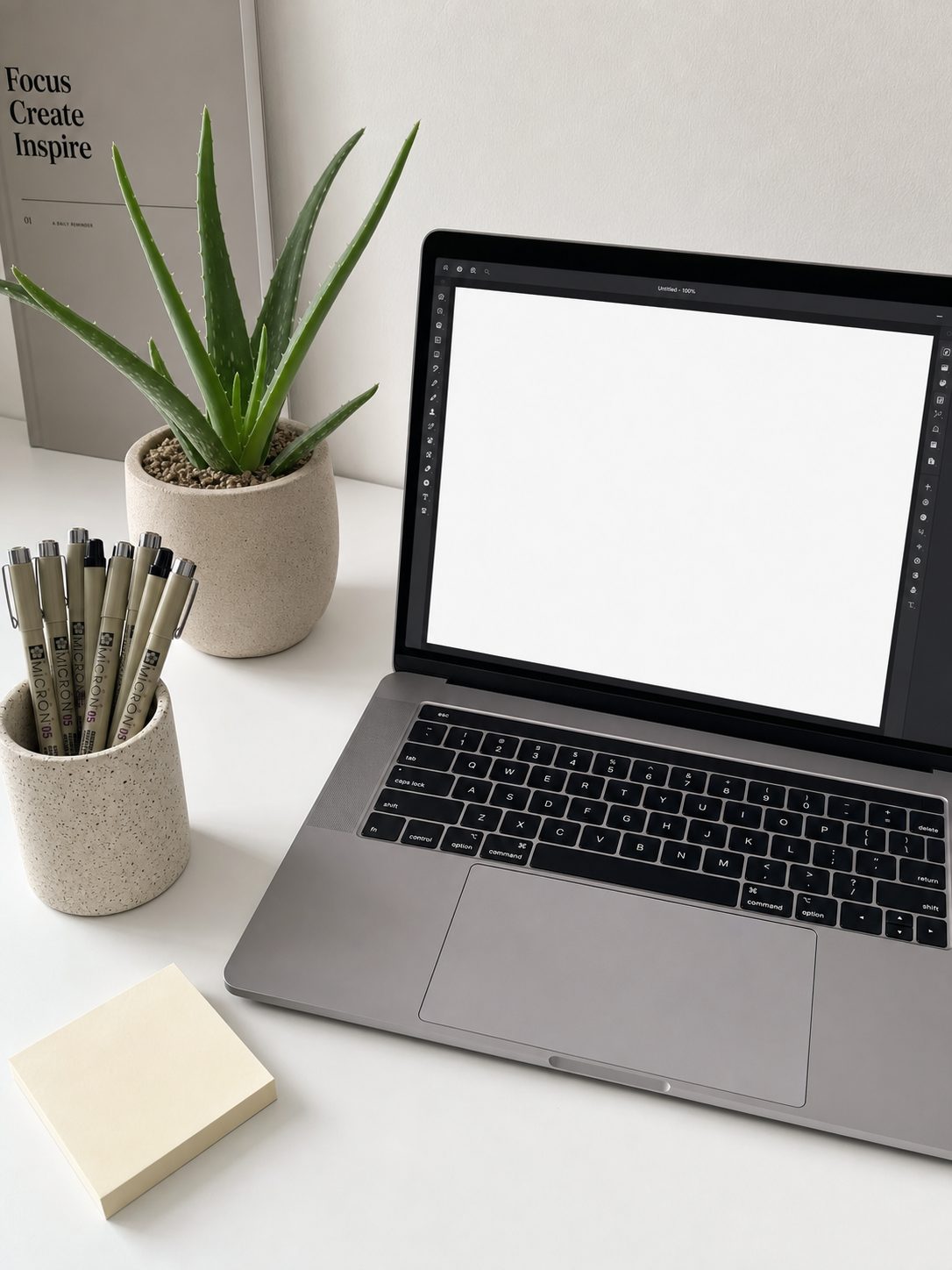
Nothing fancy. A laptop that's several years old and runs noticeably warm when it's working hard, which is most of the time when I'm in an editing session. Software I've been using long enough that its quirks feel like known territory rather than frustrations, I know where things are, I know what it can and can't do, I've stopped fighting its limitations and started working with them.
A good pair of headphones. This is the one piece of genuinely important equipment in this whole operation, maybe the only one I'd replace immediately if it failed. If I can't hear what I've filmed properly, I can't edit it properly. The headphones are non-negotiable. Everything else is negotiable.
My desk at night with the amber lamp on. The overhead light off. That's the editing setup. The lamp is a deliberate choice, it changes the quality of the hours somehow. Working under cold white overhead light feels like a task. Working under warm lamplight feels like something more considered, more patient.
I make tea and then let it go cold, which has become a reliable measure of concentration. Cold tea means I was actually in it. Warm tea means I was distracted. The state of the tea beside me is a more honest record of how the session went than anything I could write about it.
The process that took three hours when I started now takes, sometimes, on a good focused day, less than one. Not because I've become careless but because I've learned to see more quickly. I know what I'm looking for. I know the signs of a take that will work and the signs of one that won't, and I've learned which of my instincts to trust on this and which to override.
The decisions I make in the edit
What to cut: almost always more than I think I should at first pass. The edit's first instinct is always too long. Something in me wants to keep context, ensure everything is explained, leave in the beat where I pause because it feels authentic. The edit's job, which it took me a long time to understand, is to convince me that most of this is unnecessary. The viewer fills in more than you think. Ruthlessness in the edit is an act of respect for the viewer's time and, honestly, for the material itself. The tighter version is almost always the better version.
What to slow down: sometimes a moment lands better when you give it a breath. Not always, and not often, but there are moments, usually something small and human, something that nearly got lost, where slowing the pace by half a beat gives it room to actually land with the weight it deserves. I've learned to feel for these rather than follow a rule about them. They don't announce themselves. You have to watch for them.
When to let the imperfection stay: this is the decision that has required the most adjustment in my thinking over the past few months. I used to try to cut every stumble, every slight word-trip, every moment where my intonation did something unexpected. Now I leave more of these in than I remove. Not because imperfection is a brand strategy, that framing always feels slightly hollow to me, but because those moments are often where the person in the video is most actually present. The hesitation before a sentence that matters. The brief involuntary laugh before something true. These aren't flaws to be managed. They're footage. Often the best footage.
At 10pm on a November evening
This is what it actually looks like, when the editing is going well and I've found what I'm looking for.
I'm at my desk and the room is dark except for the lamp and the screen. It's November now, the darkness settled in fully since around 4pm, the permanent kind that won't lift until March. Outside the window there's very occasional traffic, muffled and distant. Someone's television next door, the laugh track that comes through the wall on weekday evenings, familiar now, something I've stopped noticing consciously but that registers as occupancy, as the general low hum of a building with people in it.
On the screen: twelve clips of the same thirty-second sequence in various states of rightness. Twelve versions of me saying the same thing in slightly different ways, at slightly different paces, with slightly different light, slightly different energy. And I'm looking for the one. The specific frame where everything works, where the light is doing the right thing and I'm saying the right words at the right pace and there's something in my face that is not performed but actual. Not trying to seem a certain way. Just being a certain way, and the camera caught it.
That frame exists in almost every session. It takes different amounts of time to find. When I find it, something clicks into place, a small physical sensation of rightness that I've come to trust. From that frame I build outward. What comes before, what comes after, what can be trimmed so that the right moment gets to land without distraction.
That is the editing process. Twelve clips and one lamp and cold tea and a single frame, waiting patiently to be found. Every polished video started this way. Every one.
What I've stopped correcting
The small stumbles. The moment where I lose my thread mid-sentence and find it again a few words later. The genuine laugh that interrupts something I was saying seriously, these get to stay now. The pause before something I mean, I've learned to distinguish the dead pause from the thinking pause, and the thinking pause gets to stay.
The face I make when I disagree with something I've just said, just for a fraction of a second, a micro-grimace, a brief internal argument visible on the surface for anyone paying close attention. I used to redo the take when I noticed this. Now I sometimes keep it because it's honest. Because it shows that I'm actually thinking about what I'm saying and that what I'm saying is not always perfectly certain. That uncertainty, visible for a moment, reads as true in a way that smooth certainty doesn't.
What I've stopped correcting, in general: the parts that are most unmistakably me. The specific speech rhythm that doesn't match anyone else's. The tendency I have to end sentences slightly higher than expected. The way I look down briefly when I'm choosing a word carefully. These things were targets of self-consciousness when I started. Now I recognise them as the signature, the part of the footage that couldn't have been made by anyone else and that is therefore, paradoxically, the part most worth keeping.
The edit is where you find the story, the camera just collects material. And what makes a piece of content feel real is rarely what was captured on purpose; it's what you find afterwards, in the patient, quiet work of looking at what you actually made.
The mess is not the failure. The mess is the raw material. The editing is just knowing what to keep.