The books that got me through autumn and what each one gave me
October is my reading month. Something about the darker evenings and the permission to stay in makes me reach for books I'd been meaning to for months. Here's what I read.
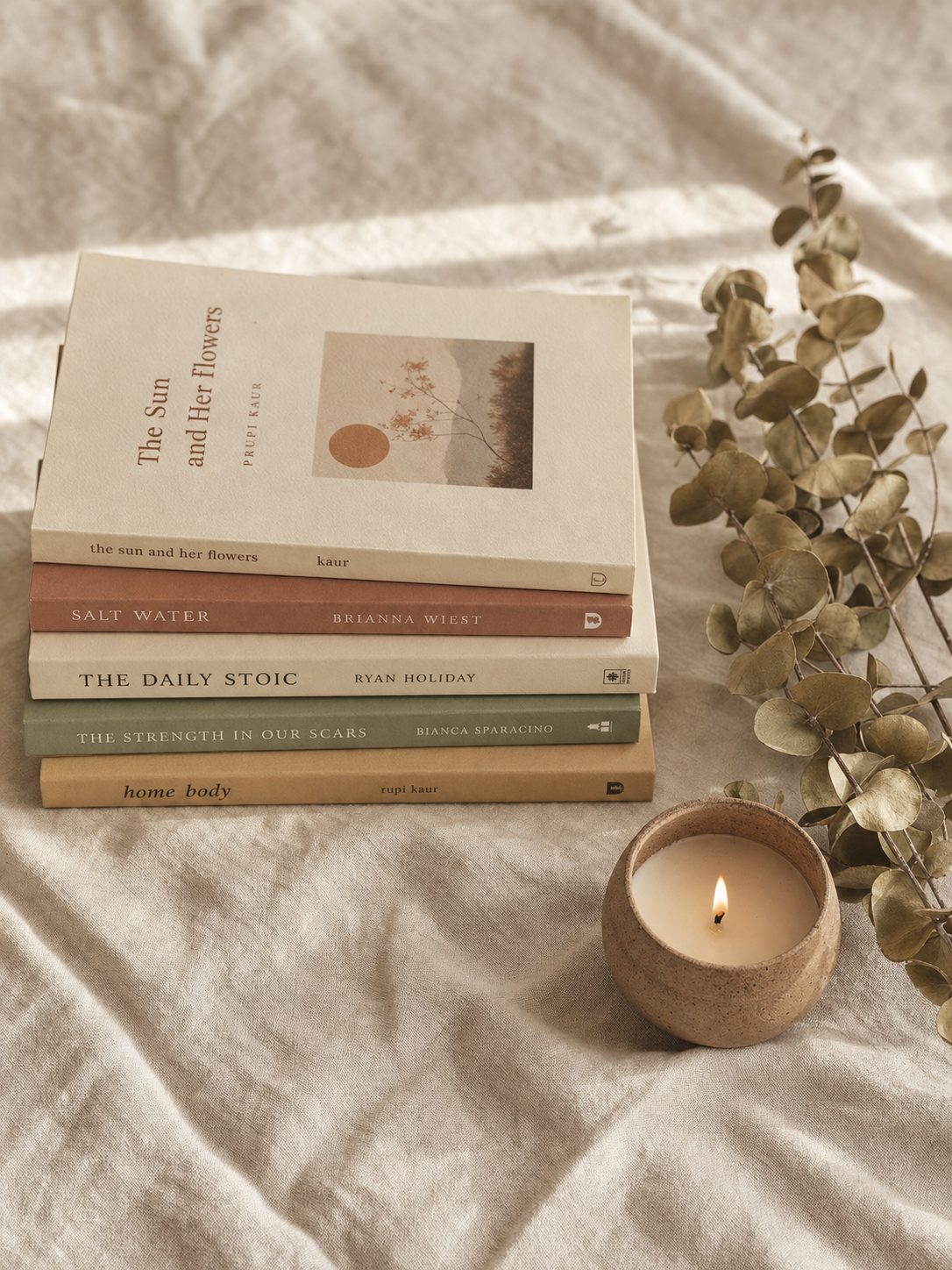
October is my reading month. I think it always has been, even before I understood why. Something about the way the evenings arrive earlier and earlier, that sudden 5pm dark that September pretends isn't coming, gives me permission I don't have in summer. Permission to be in. Permission to be still. Permission to sit with a blanket pulled up and something in my hands that has nothing to do with a screen.
This year I read more than I have in a long time. Part of that is this slower, softer version of life I've been building since I started this diary. Part of it is the darker evenings. Part of it is that I finally stopped feeling guilty about reading in the afternoon on a weekday, which I used to consider a moral failing for reasons I can no longer explain or defend. The guilt dissolved sometime in September and I haven't missed it at all.
Here's what I actually read this October. The good, the surprising, the one I almost didn't finish, and what each one gave me. Because I think what a book gives you is sometimes different from what you went looking for, and that difference is worth noticing.
The comfort read that delivered exactly on its promise
The first one I picked up in early October when I was feeling a bit tender and wanted something that would hold me gently. I'd been seeing it mentioned in the kind of online spaces I trust, quiet corners of the internet where people recommend things without trying to sell you anything, and it had been sitting in my flat for two months, which is my standard incubation period. Books often wait for the right moment. This one waited well.
It was exactly what I needed. Cozy in the old literary sense, not saccharine, not shallow, but warm. Set in a small community. Character-driven, with an eye for the small moments and the way people circle around what they can't quite say. The prose had a kind of unhurried quality that felt like a physical relief after a week of reels and comment sections and the general pace of being online.
I read most of it in two sittings, which for me right now is remarkable. I don't have the sustained attention span I used to, I notice that, and I'm not hard on myself about it, just curious, but this book asked for mine gently and I gave it without effort. That's rarer than it sounds. A lot of books ask for your attention and then don't quite earn it, and you end up reading the same paragraph three times while your mind drifts to your to-do list. This one didn't do that.
The booklove thing I've rediscovered this autumn is specifically this: a book that meets you where you are, that doesn't demand more than you have, that asks you to slow down and then makes the slowing down feel like a gift rather than a discipline. That's what a comfort read at its best actually does. Not escapism, more like company. The particular company of a voice that's thought carefully about things and is willing to share the thinking.
What it gave me: a reminder that warmth is not simplicity. That something can be gentle and still be layered. That the cosy and the literary are not in opposition and I should stop apologising when I read something that prioritises emotional warmth over intellectual difficulty. Both are valid. Both are worth reading. October needed warm.
The one that surprised me
I'd picked this one up expecting, I don't quite know. Something more surface-level, maybe. A certain kind of essay collection that's very fashionable right now, the kind that's full of knowing references and a particular brand of ironic self-awareness. I like those, I should say. But I've read a few recently and I had a sense of what I was getting into.
I did not get what I was expecting. What I got instead was something more searching, more genuinely uncertain. The writer didn't seem to have arrived at their conclusions yet, they were working them out on the page, which is the kind of writing I find most compelling and also most generous. There's a kind of essay where the writer hands you a fully formed argument, wrapped up. And then there's the kind where they invite you in while they're still figuring it out. This was the second kind.
I underlined more in this book than in anything I've read this year. Which is one of my metrics: the number of lines that say something I've felt but not found words for. There were several of those. I read one passage out loud to myself, alone in my flat, at 9pm, just to hear how it sounded in my own voice in a real room. That felt slightly dramatic and I don't regret it at all.
What it gave me: a reconsideration of the way I process difficulty. The writer had a particular way of sitting with ambiguous feelings without immediately resolving them into a lesson or a takeaway, and I found myself trying to do the same after I put it down. Just holding something uncertain for a bit longer before reaching for the answer. There's a practice in that I'm still developing.
When a book gives you more than you bargained for, it's one of the best small surprises the world has on offer.
The difficult one I nearly put down
Full disclosure: I nearly abandoned this one twice. Around page sixty the first time, I could feel that it was going to require something of me, and I wasn't sure I had it. Then around page one-twenty, when it went somewhere I found genuinely hard. I put it down, made tea, sat with it, let it be hard for a while, and then picked it up again. Not immediately. The next evening.
I'm telling you this because I think there's something worth naming about the experience of reading something difficult. Not difficult in the pretentious sense, I have no patience for books that are obscure for obscurity's sake, but difficult in the sense that it's touching something you'd rather leave untouched. That particular resistance is interesting. It's worth paying attention to. When you feel yourself wanting to leave something, the reason is worth examining.
What the perseverance gave me, and I did persevere, I finished it on a Tuesday afternoon in a single concentrated sitting, was something I'm still processing. Not a lesson, exactly. More like a recalibration. A reminder of something I knew but had let slip. About patience. About the way difficult things don't resolve cleanly. About the value of sitting with ambiguity instead of reaching for easy comfort. Also, and this is harder to articulate, something about grief. Not my specific grief. Just the shape of it in general, and how it moves through people and time and comes out changed on the other side.
The books that are easiest to put down are sometimes the ones most worth finishing. I'm not sure I can fully defend that as a rule. But it's been true for me more often than not. The resistance is sometimes telling you something important about what the book is touching in you, and that thing is worth knowing.
A rain-heavy evening and the amber lamp
I want to describe a specific evening because it's one I'd like to be able to come back to, and this soft little diary is partly where I store the good ones.
It was a Thursday, mid-October, somewhere around 7pm. The rain had been coming in sideways since lunch, the particular aggressive October rain that makes the window glass look like it's moving, and the flat smelled faintly of the candle I'd lit earlier in the afternoon, something warm and slightly smoky. The lamp in the corner, the little amber one, was on. I'd eaten early. My phone was face-down on the kitchen counter where I'd left it to charge.
I was reading the difficult book, the one I'd nearly put down twice, and I was at the part that had already made me cry once and was making me want to again. The blanket was pulled up to my chin, the heavy knitted one that lives on the sofa arm from October through to March, where it earns its existence. The tea in the mug beside me had gone a bit cold. I'd forgotten to drink it, which only happens when I'm really in something.
The window was streaked and the outside world was very far away. The traffic sounds were muffled by the rain. Someone upstairs was cooking something; I could smell it faintly and it was companionable in the way that neighbours' cooking smells often are, the reminder that you're not alone in a building, even when you're alone in a room.
I read twenty pages I didn't mean to read. Lost an hour I'd ostensibly set aside for something else. Felt no guilt about it whatsoever.
There's a specific quality to reading like that, deeply, outside of time, with the rain outside and the amber lamp and the cold tea, that I think is one of the most generous things you can do for your mind. Not informative reading, not productive reading. Just being fully absorbed in someone else's thought. Letting your own anxieties step quietly aside for a while. Your nervous system, which deals with so much noise all day, just… resting inside language. There's nothing quite like it and I've been neglecting it for too long.
What I'm reading next
I have two books on my bedside table right now and I'm making myself choose just one to start properly instead of grazing at both, which is a bad habit I have. Starting two things and committing to neither is my particular form of literary indecision and it results in finishing neither, which helps no one.
One is a novel I've been meaning to read for years, the kind of "I'll get to it eventually" that eventually becomes its own embarrassment. October felt like the right time and I said that and then didn't start it, so November is the time. Something about the autumn-into-winter transition feels right for it. Certain books feel like they were designed to be read in a specific season, and this one is dark-evenings reading.
The other is a book of essays about solitude and attention. I'm drawn to it for obvious reasons that I don't need to examine too hard. I already know I'm going to like it and I'm saving it slightly, the way you save a good biscuit, just a little longer than necessary, because the anticipation is part of the pleasure. I'll start it when I feel ready to be properly stretched, which might be December.
I'm going into November wanting to protect my reading habit the way I'd protect any practice I care about. Making the space for it deliberately. Putting the phone down earlier. Letting the evenings be long and lamp-lit and full of other people's sentences.
- Phone off or face-down by 8pm, at least three nights a week.
- Book on the sofa table, not the bedside, so I reach for it before I think about the alternative.
- No reading with a timer running. When reading becomes a task to complete, it stops being the thing I need it to be.
Reading is one of the most generous things you can do for your mind, not because it makes you smarter, but because it reminds you that your own experience is neither as unique nor as isolated as it sometimes feels.
We're all in here, struggling and wondering and occasionally losing an hour to a streaked window and an amber lamp. Books are the evidence of that. The particular evidence that someone else felt this too, put it into words before you needed the words, and left them there for when you did. I find that enormously comforting. 🤍