On filters, real faces, and the quiet work of liking what I look like
For a few weeks I was using a smoothing filter on almost everything. Then one day I watched an unfiltered video back and felt a flash of something I didn't want to feel about my own face. That felt like information.
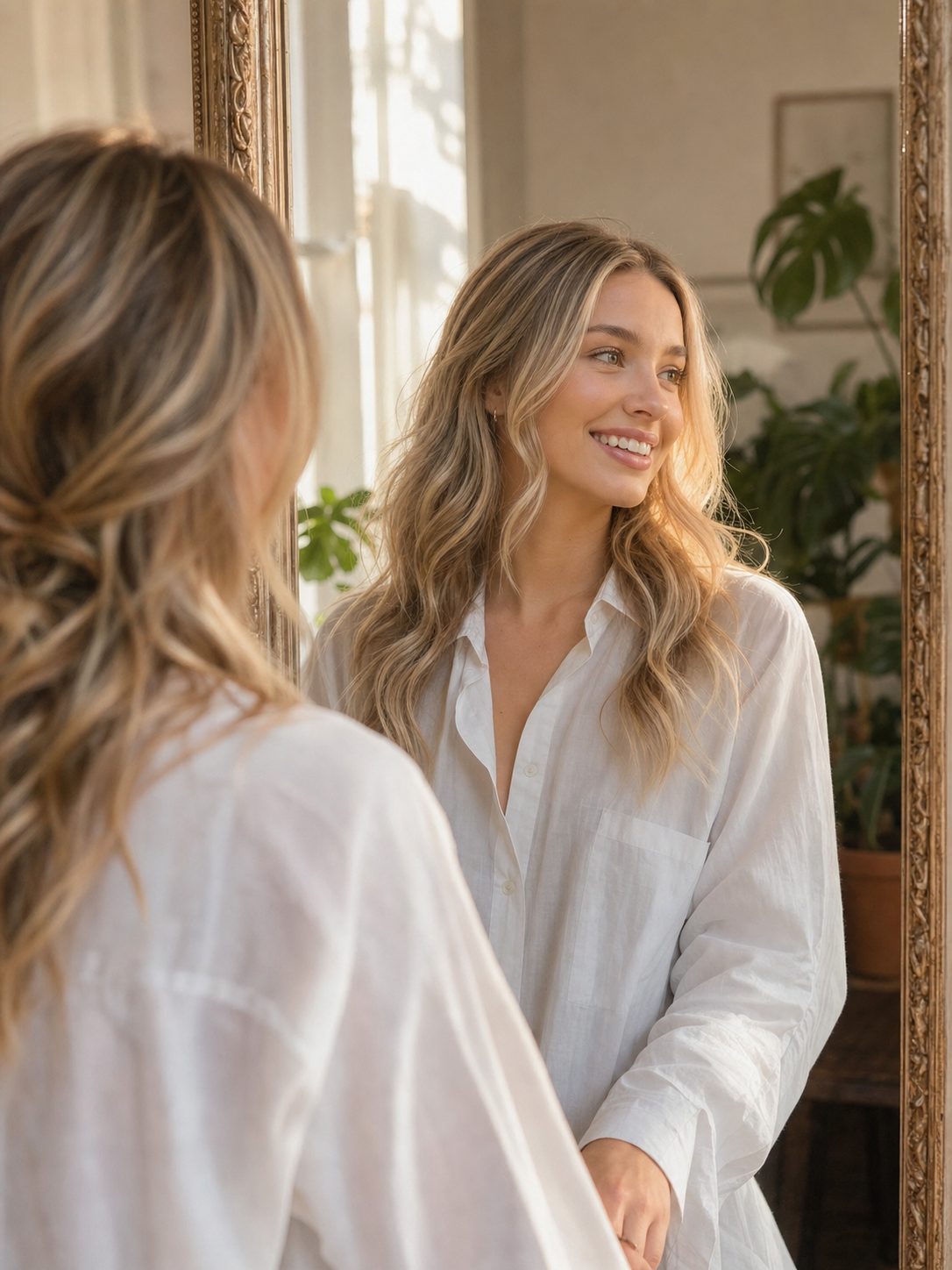
For a few weeks in September and October I was using a smoothing filter on almost everything I posted. Not a dramatic one, not the kind that moves your features around, not the kind that makes you look noticeably different to people who know you. Just a mild skin-smoothing thing. The kind that's become so normalised in online video that you often can't tell it's there, which is perhaps the whole point. It just makes you look like a very slightly better-lit, very slightly more uniform version of your face. Less texture. Softer edges. The kind of difference you can't name but you register.
It started without a decision. I discovered it existed in the app I was already using, tried it on a clip where my skin had been particularly red and blotchy from a warm afternoon, thought: this is better, and then just kept using it. That was all. No deliberate moment where I said to myself: I'm going to alter how my face looks going forward. It just became the default. The way defaults do, quietly, invisibly, until you're two months in and haven't thought about it since the first week.
And then one afternoon I was going through my older clips, the summer ones from when I first started posting, the ones where I was nervous and the content was rough and my setup was worse than it is now, and I saw my face without the filter. And I felt a flash of something I immediately recognised as significant.
The feeling was: that looks wrong. My own face, in unfiltered daylight, looking the way it has looked my whole life, looked wrong to me. That felt like information I needed to sit with.
How the filter habit works
It happened gradually and I think that's the whole mechanism. If the filter had immediately, dramatically changed how I looked, if I'd watched back the first filtered clip and barely recognised myself, I'd have noticed it as a change and made a conscious decision about whether to continue. But the mild version doesn't work like that. The mild version just smooths. And the brain, which is always recalibrating to whatever it sees most frequently, simply accepted the filtered version as the face. As the reference point. As normal.
So when the unfiltered video appeared, same face I've always had, the same face everyone who has ever met me actually knows, it looked wrong not because it was worse, but because it had become unfamiliar. Unfamiliar doesn't mean wrong, I know that, I say that, and this was a direct test of whether I actually believe it when it applies to my own reflection.
The research I went and did afterwards was both clarifying and slightly distressing. Skin-smoothing filters work by reducing texture. And texture, it turns out, is actually quite important in how we process a face as real, as present, as belonging to an actual person. The micro-variations in skin, the slight unevenness, the pores, the way skin moves differently over different expressions, are part of how faces communicate aliveness. Smooth them away and the face reads as more conventionally beautiful by certain algorithmic measures, and simultaneously as slightly less person, slightly more image. Slightly less there.
The eyes filter trend, that specific thing of enhancing brightness and size and symmetry around the eyes while smoothing everything else, works on a similar principle but amplified. Bigger, brighter, more symmetrical eyes on a smoother surrounding face. It reads as more. But more of what, exactly? More of a template. More of a face that has been optimised toward an algorithmically-understood ideal. Less of the actual person behind it.
I'm not speaking in sweeping terms about filters in general, there are people who use them thoughtfully, knowingly, as a creative choice they've made with full awareness of what they're doing. But for me, what had happened was not that. What had happened was a quiet, undecided installation of a new standard. I hadn't chosen the filtered face. I'd just stopped choosing the unfiltered one.
The decision to stop
I posted an unfiltered video in late October. It was not a statement. I didn't write a caption about it, didn't explain what I was doing, didn't make the absence of a filter into content about filters. I just posted the video. The regular one. The one with the skin I actually have and the slight asymmetry in my face that I've had my whole life and the texture that is simply what faces are like in real light.
The comments I got: mostly either normal, about the content of what I was saying, which is what comments are supposed to be about, or, interestingly, slightly warmer than usual. A few people said things like "you look so natural" or "something feels different in a good way" without specifying what. They had noticed something, even if they couldn't name it. They'd noticed the presence of something the filtered videos had been quietly removing.
The comments I'd already written in my head before posting: a whole pre-emptive inventory of catastrophes. It will look too raw. People will see things. Someone will say something unkind about my skin. The inner critic doing what it does, threat assessment, worst-case preparation, the very convincing rehearsal of disasters that almost never actually arrive.
None of the catastrophised comments came. They rarely do. The disaster we rehearse in the hour before posting is almost never the one that materialises. This is useful information that I have now confirmed many times over and still don't fully trust until the next time, when I have to confirm it again.
Standing at the mirror in November morning light
A few days after I started posting without the filter, I did something I don't usually do: I stood at the mirror in the morning and actually looked. Not the checking look, the quick assessment before you leave, the scan for problems. Actually looking. With curiosity rather than evaluation. The particular undramatic ordinariness of an actual face in ordinary morning light.

The November morning light through the bathroom window is not flattering in the conventional sense. It's the flat white of an overcast morning, no warmth, no shadows to contour with, no golden hour doing any work. Just light, showing you the face you have with no particular assistance.
Lines I don't have in good photography. Texture that the filter had been removing. The way one eyebrow sits fractionally higher than the other, something I've known since childhood and rarely think about until a morning like this. The thing that happens to the skin under my eyes when I haven't slept quite enough, which the filter had been quietly addressing on my behalf without my having asked it to.
I stayed with it. Not in a punishing way, not forcing myself to stare at what I "really look like" as some kind of corrective exercise. More in the gentle, curious way of being properly introduced to something you've been living with for a long time. The face I eat breakfast with. The face I film with. The face that the people who love me, the friends, the people who knew me before any of this, see when they look at me.
And after a few minutes, something shifted: the face in the mirror started to look like me. Not like an image of me. Not like the best-light version of me. Not like me processed through a smoothing filter. Just me. That person. The one that exists when no one is performing anything.
The quiet work of finding it likeable
I want to be careful here, because I think this is where the conversation can get dishonest if I'm not precise. I'm not at the point of fully, unconditionally, every-morning-easily loving my face. I don't think that's required. I also don't think, for most people, it's particularly realistic, and the "you are beautiful exactly as you are" messaging, while well-intentioned, asks for a certainty I'm not sure many people actually have, and I'm not willing to perform a certainty I don't feel.
What I'm actually working on is quieter and more achievable than that. I'm working on finding the regular face not actively wrong. Not something to be managed. Not something that requires filtering before it's allowed to be seen. Just a face. My face. Ordinary and textured and slightly asymmetrical and the one that has existed through everything I've lived through.
Some days this is easy. Some days I look in the mirror and feel straightforwardly fine about what I see and go about my morning. Some days the old commentary starts up, too this, not enough that, the filter would, and I have to notice it as commentary rather than fact. Notice it and not believe it. That's the work. Not the feeling, but the relationship with the feeling.
I've been filming unfiltered for a few weeks now. Some videos I've watched back and felt warmly neutral. Some I've watched back and noticed things I would have changed, and had to practice not changing them. The practice is: notice the impulse, sit with it for a moment, ask whether acting on it serves me or only serves the imagined standard, and let it go if it's the latter.
The face you have is the one the people who love you recognise. That's not a consolation prize. That's the whole point.
Unfamiliar doesn't mean wrong. The unfiltered face isn't lesser, it's just less curated. And I'm finding, slowly, that less curated is more myself. Which is what this soft little diary is for, more than anything else: being more myself, in public, until it starts to feel natural.