Getting comfortable being on camera (from someone who still isn't fully there)
I have watched back footage of myself and immediately deleted it. I have also watched some back and felt something that might be tenderness. Both happen. Six months in, here's where I am.
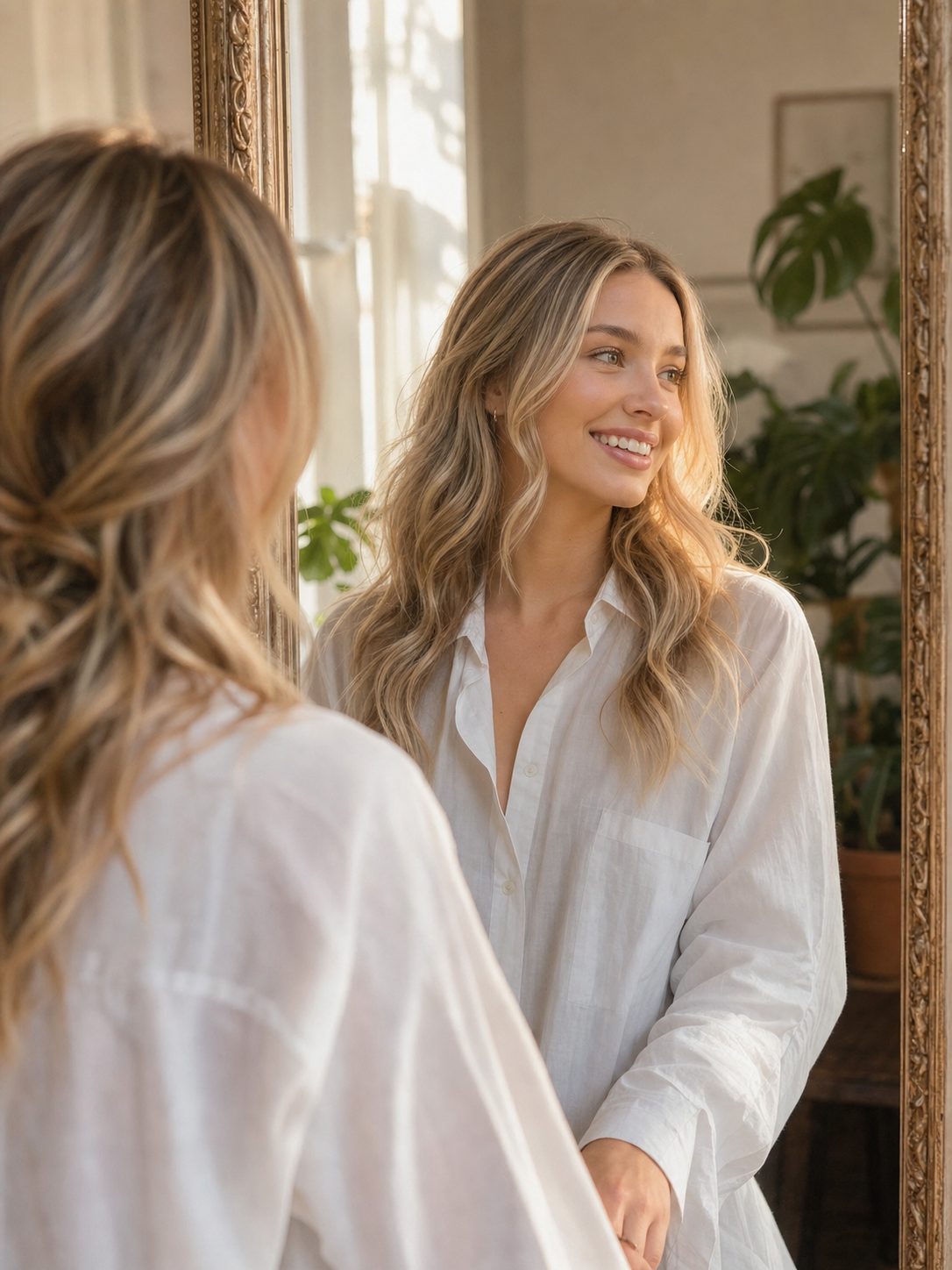
I watched back a video from June this morning. Not on purpose, it came up in my own camera roll while I was looking for something else, and I watched about forty seconds of it before I had to put the phone face-down on the desk and just sit with the embarrassment for a moment. Not because it was bad, exactly. It was fine. But the person in it was trying so hard. Shoulders held at a particular height. Enunciation careful in a way that suggested she was monitoring every syllable. Face doing something I can only describe as performing attentiveness rather than actually being attentive. The whole thing had the texture of someone trying to pass as natural rather than someone who actually was.
That was six months ago, approximately, which means I've been making videos for about six months now, which is a fact that surprises me slightly every time I hold it. Six months of a camera pointing at my face. Six months of posting before it felt perfect, or trying to, on the better days. I am not fully comfortable on camera. I want to be honest about that up front. But I'm somewhere different from where I started, and the distance between those two points has been instructive in ways I didn't entirely anticipate.
What the early videos looked like
There is a specific kind of stiffness that comes from being too aware of yourself. I've seen it in other people's early videos and I saw it in my own: the movements are slightly too deliberate, the pauses slightly too considered, the whole thing calibrated to look like ease rather than actually being easeful. You can't quite relax your jaw. Your hands don't know what to do. You speak at a pace slightly slower than the one you use when you're not being filmed, because you're processing your own performance in real time.
My early videos were competent in that way. Correctly lit, because I'd read about lighting. Correctly framed, because I'd read about framing. The content was fine, things I meant, things I'd thought about. But there was a layer of performance over the top of it that made the whole thing slightly armoured. Watchable but not particularly warm.
I remember filming one in early July and feeling genuinely pleased with it while filming, and then watching it back and feeling a specific kind of deflation. The face I had on screen wasn't quite the one I wore in real life. Some process of self-consciousness had filtered it into something slightly different, slightly smoother, slightly less mine.
What I learned from watching other people
There's a creator, I'm not going to name her, but she's someone I find genuinely compelling to watch, who does something in her videos that I spent a long time trying to identify. She seems completely at ease. Not professional-ease, the kind that comes from training and broadcast confidence. Actual ease, the kind you have with someone you trust. And I kept watching trying to figure out what was producing that quality.
What I eventually noticed: it's the mistakes. Not obvious, distracting mistakes, just the small ones. The moment where she loses her train of thought mid-sentence and laughs at herself. The pause that runs slightly too long. The word she says twice. All the things that a highly edited video would remove, these are the things that make her feel real, and feeling real is the quality that makes something genuinely watchable.
This is what I was trying to edit out of my own content: the very things that were making other people's content feel human. There's something almost backwards about it. The more perfectly smooth the video, in a certain register, the more performance it signals, and the more performance it signals, the less connection it creates. The yourself video, the one that feels like you actually watching yourself on a random Tuesday, is the one that reaches people, not the one where you showed up as your best, most polished version.
The camera finds the real thing eventually. You just have to keep putting yourself in front of it long enough for the performance to get bored and go home.
The practice that helped most
For a while I had a habit of filming something and then watching it back immediately to assess. This felt like a responsible creative practice, review, learn, improve. What it actually did was create a feedback loop that made me more self-conscious with each film session rather than less. I'd watch back, notice the things I didn't like, try to correct them in the next take, and in trying to correct them I'd introduce a new layer of monitoring that produced a different set of stiffnesses.
The thing that helped most, and this felt counterintuitive when I started doing it, was filming and not watching back immediately. Just posting. Or filing away. Not reviewing right away. Removing the immediate evaluation loop meant I was filming from instinct rather than from the accumulated notes of previous self-assessments. The recordings got looser. More like how I actually speak. More like the person I am when I'm explaining something to a friend rather than presenting to an invisible panel of judges.
The other thing that helped was talking to the camera like it's a specific person rather than a generic audience. I started imagining someone I actually liked and respected, and talking to that person. Not performing for them, just telling them something I thought would be useful or interesting. The energy shift when I do that is immediate and visible in the footage, everything relaxes by about thirty percent.
A December morning in front of the camera
Last week I filmed something in my bedroom on a December morning. The lamp was on, it was still dark outside at seven-thirty, which is the reality of December, and I'd just made tea and I sat on the edge of the bed and started talking. I didn't write anything down first. I'd been thinking about something for a few days and I just wanted to say it.
I looked at myself in the viewfinder, that small rectangle of my own face on the screen, and I made a decision in the moment to trust it. Not to monitor it, not to calibrate it, not to try to make the face in the rectangle into a better or smoother version of my face. Just to say the thing I was thinking, in the way I actually think it, and let that be enough.
I watched it back two days later, after I'd already posted it. And something happened that I want to name carefully because it was new: I felt something like tenderness. Toward the person on the screen. Toward the slightly imperfect way she searched for the word she wanted and then found it. Toward the fact that her hair was not quite right in the morning light and she clearly didn't care. That was a me I was willing to look at. It took six months to get there.
What I've stopped caring about
The angle. Specifically, whether it's the "most flattering" angle, a concern I spent an embarrassing amount of early time on, as if being slightly more flattering would make the content more meaningful. It won't. People are not watching for the angle. They're watching for the feeling that a real person is talking to them.
The background. I film in my bedroom, my living room, occasionally my kitchen. The backgrounds are real rooms I live in. There's sometimes laundry visible. There's sometimes a mug I forgot about. I used to move everything out of frame. Now I leave it because real rooms have things in them and that's fine.
The imperfect lighting. December at seven-thirty in the morning with one lamp has a specific quality that isn't professional and isn't particularly flattering and is exactly what a December morning at seven-thirty looks like. I've decided that authenticity of atmosphere is worth more than controlled lighting. I reserve the right to change my mind about this.
This is just where I am at six months in. Still learning. Still occasionally filming something and feeling relieved rather than proud. Still sometimes deleting a take because it felt too stiff and trying again. But also, increasingly, feeling something I couldn't feel at the start: like the camera and I are slowly becoming acquainted. Like trust is being built, incrementally, through the repetition of showing up. That's the whole thing, I think. You just keep putting yourself in front of it.
For anyone who's still in the stiff-shoulders phase
I want to address this directly, because I know what that phase feels like and I remember reading things about getting comfortable on camera when I was in it and feeling like the advice was aimed at a version of me I hadn't become yet.
If you're still in the phase where every watch-back is a form of mild self-punishment, where you can't quite look at your own face on screen without cataloguing what's wrong with it, I want to say this: that is incredibly normal, it passes at its own pace, and you can keep making videos while you're still in it. You don't have to wait to be comfortable before you start. The comfort comes from the doing, not from the waiting to do.
The yourself video, the one that shows who you actually are, in the actual light of your actual room, with your actual face doing its actual expressions, is always going to be better than the video where you tried to make yourself look or sound like a more polished version. Always. Even when it doesn't feel that way on the watch-back. The people on the other side of the screen can feel the difference between performed ease and actual ease, and they will keep watching the actual thing even when it's imperfect, especially when it's imperfect, because imperfection is what presence looks like up close.
Keep going. Be patient with the version of yourself who's still figuring it out. I am also that person, just slightly further along the road than I was at the start. And the road continues in both directions, which is maybe the most reassuring thing I can say about it. 🤍