My small home office makeover and why it took me so long
For about a year I had been working at a desk that made me feel vaguely low-grade unhappy every time I sat down at it. I kept not fixing it. Then last September I finally did.
For about a year I had been working at a desk that made me feel vaguely low-grade unhappy every time I sat down at it. I want to be specific about the word vaguely, because it was genuinely vague, not a strong unhappiness, nothing dramatic, just a mild and persistent wrongness that I'd filed under "just how things are" and stopped noticing. The way you stop noticing a scratch on the wall or a drawer that catches. You adapt. You lower your expectations. You sit down and open the laptop and try to work anyway.
I kept not fixing it. Every few weeks I'd think about it, there was this list in my head of things the desk needed, and then I'd get distracted by something else and the desk would go back to being the thing I just lived with. I think part of me had decided that the effort of addressing it would be greater than the benefit, which turned out to be completely wrong. The effort took one Saturday. The benefit has been ongoing for weeks.
What it actually looked like
The original situation, before the Saturday, was this: a desk that had approximately three cables running visibly across it to various things, gathered loosely with a hair tie I'd used as a temporary solution about eighteen months ago. Mug rings on the wood surface, because I always forget to use a coaster and the surface had paid the price over time. A pen pot made of some kind of pale blue plastic that I'd bought in a moment of urgency and never replaced. A pile of things on the right side, papers, a charger, a notebook that had sort of migrated there from the bookshelf, that had been growing for long enough that I'd stopped registering it as a pile.
What I had was a cute office setup concept, in theory, undermined in practice by years of accumulated not-quite-managing. The desk was not ugly, exactly. The bones were fine, a wooden surface, decent height, good position near the window with natural light. But everything on it was slightly wrong. Slightly mismatched. Slightly not chosen, just arrived.
That's the honest version. I sat down at it every morning and something in my brain registered the chaos before I'd even opened a document, and I brought that register into my work without ever quite identifying it as the source of the low-level resistance I sometimes felt.
The Saturday
I started at ten in the morning with a second cup of tea and moved everything off the desk first. The whole surface. Every cable, every pen, every migrated notebook, the mug, the plastic pen pot, the little pile on the right. I piled it all on the floor and looked at the bare wooden surface for a moment.
Clean. It looked immediately better clean. Which told me something about how much of the problem was just accumulated stuff rather than anything requiring a purchase.
I cleaned the surface properly, the mug rings didn't come out entirely but faded significantly, and then I thought about what the desk actually needed to function well, rather than reaching for things to buy. The answer was more restrained than I expected. A way to manage the cables. Something to put pens in that I'd actually chosen. A plant, because every surface I love has a plant on it and this one didn't.
The rest of the Saturday was moving, cleaning, and rethinking the layout. I moved the desk two feet to the left, which sounds small but changed the relationship to the window in a way that materially improved the light. I found three things in other parts of the flat that actually belonged on the desk, a small ceramic dish for the daily things I need access to, a lamp I'd been using elsewhere but which suited the desk better, a notebook I wanted within reach. These didn't require buying. They required noticing and moving.
The three things that made the biggest difference
I bought three things. Just three, specifically chosen rather than impulsively acquired, and the restraint made each one feel more significant rather than less.
First: a cable organiser. The kind that sticks to the underside of the desk surface and routes cables out of sight. The relief of this was instant and slightly absurd, I hadn't realised how much visual noise three cables made until they were gone. The desk surface looked immediately larger and calmer. One small object, stuck under the wood, and the whole desk changed.
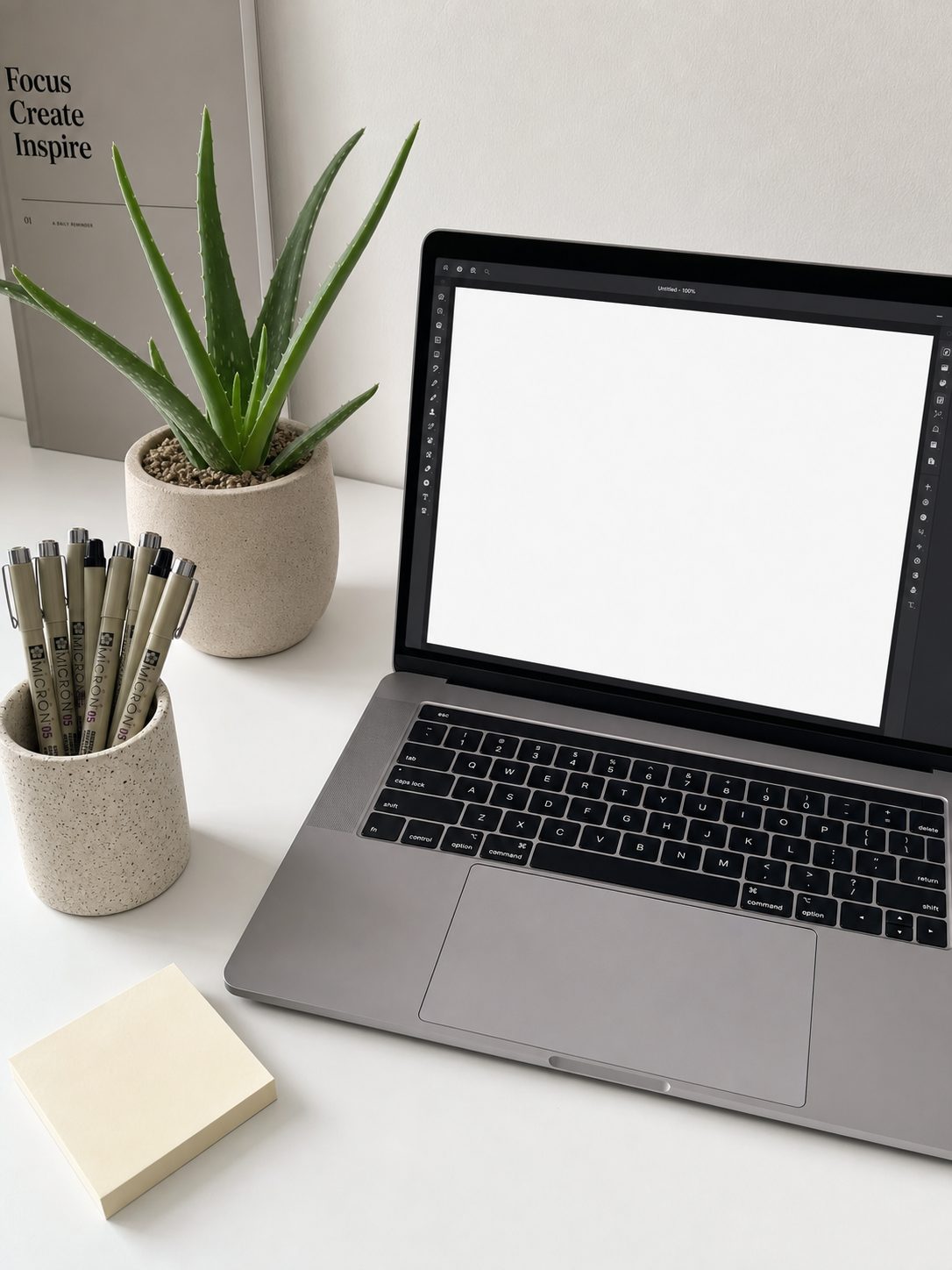
Second: a small plant. An aloe, because I've killed most plants I've owned and aloes are forgiving of my neglect and sit well in small pots. It went in the upper left corner of the desk where there had previously been nothing but bare surface, and it did something for the whole area, something warm and alive that the desk had been missing without me knowing to name it.
Third: a matching set of small desk accessories, a pen holder and a tray for small objects, both in the same material, a kind of warm clay ceramic. They replaced the sad blue plastic pen pot and the ceramic dish I'd improvised from the kitchen. They were not expensive. But they were chosen, intentionally, to go together, and the coherence they brought was noticeable enough that I stood back after putting them in place and actually felt something lift.

Monday morning at the new desk
I sat down at the new setup on Monday morning with my tea and opened my laptop. And before I'd looked at a single document, something in me was already quieter. The surface was clear. The cables were gone. The plant was there. The lamp was in the right place and the light from the window was hitting the desk differently because I'd moved it two feet to the left.
My brain registered this new version of the space and, in the way it had been registering the old version, with that subtle low-grade wrongness, it registered this one with something like ease. Like the space was saying: you can think here. This is a place for making things.
- The cable organiser under the desk, out of sight, out of mind.
- The aloe in the corner, steady and alive.
- The ceramic accessories that just go together, finally.
- The lamp moved from the shelf to the desk where it actually belonged.
- The two-foot shift in position that changed the whole relationship to the light.
Your environment shapes your output more than you think. Not because things make you creative, but because the right space stops actively working against you.
I finished the Saturday and felt genuinely pleased in a way that surprised me. It was one afternoon of effort. Three purchases and some rearranging. And the difference, sitting at the desk that evening with a notebook, just thinking, enjoying being in the space rather than tolerating it, was real in a way I hadn't anticipated.
What I wish I'd done sooner
Honestly: all of it. I wish I'd done it a year earlier, which is roughly when the resistance started and roughly when I first put it on the mental list and left it there. The gap between noticing a problem and addressing it is one I close too slowly in general, I think I'm waiting for the problem to become urgent enough to justify the effort, not realising that low-grade friction is also a form of cost. It just costs me slowly, in ambient energy, rather than all at once.
The desk was costing me something. Not dramatically, but consistently. Every morning, that small registration of wrongness. Over a year that adds up. The hour I spent fixing it has been paying back dividends every morning since, which is the kind of arithmetic I need to remind myself of the next time something goes on the list and stays there.
If you have a corner like mine, a space you use daily that you've stopped really seeing, that has accumulated its way to slightly-wrong, the Saturday is worth it. Not a grand renovation. Just a clear surface and honest rethinking of what actually belongs there.
I've been thinking since the desk Saturday about why environment affects output as much as it does. My working theory is that it's not about the desk itself, it's about what the desk communicates to you when you sit down. A chaotic surface full of unresolved things says: there's a lot wrong here. An organised surface with things intentionally placed says: this is a space prepared for you. Both messages land before you've consciously registered them. Both shape the way you approach the work.
The cute office setup content I see online often makes me roll my eyes a little, the perfectly placed plants and colour-coordinated accessories can feel performative rather than functional. But I think beneath the performance there's something real: the idea that your working space is worth caring about. That it's not trivial to want to sit somewhere that feels good. That the ten minutes spent clearing the surface or the Saturday spent rethinking the layout are legitimate investments in the quality of your work and your mood, not vanity projects to be dismissed.
I would have dismissed them, a year ago. Now I have an aloe in the corner and cables that are hidden and a ceramic pen holder I chose on purpose, and I sit down every morning in a space that says: you're welcome here. Get to work. That feels worth the Saturday.
The aloe is doing well, by the way. Extremely unfussy. Perfect for me.