What slow-travel living taught me about what I actually need
The concept of small-space living has always appealed to me more in theory than practice. Then I had a weekend where I tried a version of it by accident and everything made more sense.
The concept of small-space living has always appealed to me more in theory than in practice. In theory I find it romantic, the idea of everything you need within arm's reach, no excess, just the essentials arranged thoughtfully in a compact and purposeful space. In practice I live in a flat that is generously cluttered and I have never successfully kept a minimalist anything for longer than about three weeks.
Then I had a weekend where I tried a version of it by accident and everything made more sense.
I booked a tiny cabin impulsively. This is not my usual mode, I tend to over-research holidays and then book them six weeks before and then make lists for the packing, but something about this was different. It appeared in my feed on a Tuesday evening. A small lake, a wood burner, a description that used the words "off-grid" and "simple." I looked at it for maybe forty seconds and clicked book. The booking was for ten days later. I had no plans for the trip, which was also unlike me.
The edit before I even left
Packing for a place that has almost nothing, a wood burner, a kettle, a small stack of donated paperbacks, and one of those little lamps that runs off a car battery, is a different exercise than packing for a normal trip. There isn't space for the "just in case" items that usually constitute about forty percent of my bag. The tiny cabin didn't have a wardrobe, just two hooks on the wall. I took what would fit in a medium backpack.
That edit, before I'd even arrived, felt like relief. Not the mild relief of a problem resolved, something more substantial than that. Something in me exhaled when I looked at the packed bag and realised how little it held and found that I couldn't think of anything I'd actually missed. The just-in-case items, absent, didn't seem to matter. The optional things, left at home, didn't feel like losses.
I drove up on a Friday afternoon, the early September light already golden and autumnal by three o'clock, and arrived at the cabin just before dusk. It was smaller than the photos, they always are, and I was immediately, unreasonably glad about that. Small things feel contained. Contained things feel manageable. I put my backpack down on the one chair and looked around the one room and thought: this is everything. And it was.
How quickly I adjusted to less
The thing about needing less is that you don't notice you need less until the excess is gone. Back in my flat I have options, of things to wear, things to use, things to fiddle with or rearrange or scroll through when I'm restless. The cabin had no options. There was one mug. One throw. The stack of paperbacks and the wood burner and the view of the lake from the one window, which changed from hour to hour in a way that was more than enough to look at.
I adjusted within about two hours. Not reluctantly, actually, genuinely. The constraint resolved something. Without options to manage, I just did the next natural thing. I was cold, so I lit the wood burner. I was hungry, so I made the one simple meal I'd brought ingredients for. I was awake and it was evening, so I sat with the paperback by the lamp and read until I was tired. There was no negotiating with the list of possible things I could be doing. The list was short. The path was obvious.
The particular calm of cozy, simple living, the kind that gets idealised online in van-life and cabin-content and all those beautiful images of people being warm in small spaces, I always suspected it was partly fiction, partly the result of good lighting and the absence of wifi. And the lighting was good. And there was no wifi. But the calm itself was real. It wasn't performed or curated. It was just what happened when the excess was removed.
The lake at dusk
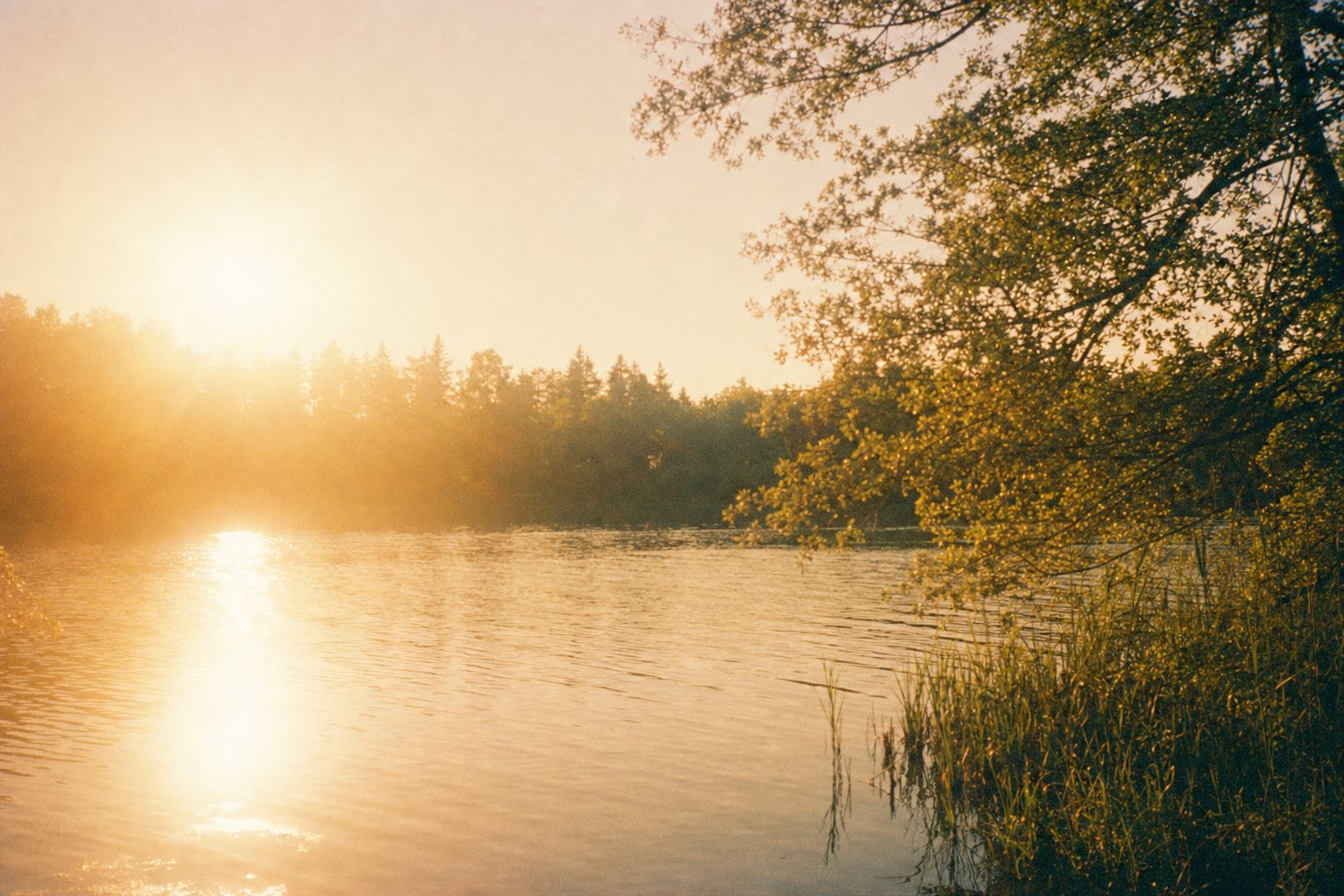
Saturday evening I sat outside on the small wooden step at the cabin's front door, just a step, no proper seating, and watched the lake at dusk. The lake was about thirty metres from the door. The wood burner was already lit inside and the smell of it drifted out, that particular smoke-and-warmth smell that means shelter, that means something was lit for you.
The light on the water went through about four different versions of itself in the half-hour I sat there. First the gold of low sun on still water. Then a cooler, more silver quality as the sun dropped behind the tree line. Then the deep blue of imminent dark, the water going almost indigo. Then the last of it, that brief, luminous grey before full dark, which lasted maybe five minutes and was the most beautiful of all.
I didn't take any content photos during this. I took one for myself, a single image for the folder I keep just for me, the one I've been slowly filling with moments I want to anchor to, and then I put the phone in my pocket and just watched. No wifi meant no background noise in my head about whether I should be making something of this. It was just a lake. Just me. The silence that comes from having no signal, which is a specific quality of silence I've rarely experienced in my adult life.
I sat there until I was cold enough that the wood burner inside felt genuinely welcoming rather than just comfortable. Then I went inside and made tea and read for two more hours and went to sleep at ten o'clock.
What I came home wanting to change
I came back to my flat on Sunday evening and stood in the middle of it and saw it with cabin eyes. Which is to say: I saw a lot of stuff. Stuff that wasn't doing anything, that wasn't earning its place, that was just present through accumulated inertia, the slow drift of objects that comes from living somewhere for a few years and never seriously editing.
I didn't do anything about it that evening. I was tired from the drive and full of the particular post-cabin peace that I wanted to preserve for as long as possible. But the following week I cleared three things: the stack of magazines that had lived on the coffee table for eight months unread. A collection of decorative objects on the windowsill that I'd stopped seeing. Three extra throws that I'd been storing in a corner because I couldn't decide what to do with them.
Three things. Not dramatic. Not a whole-flat overhaul. But the difference, the way the cleared surfaces felt when I sat in the room that evening, was immediately noticeable. The room breathed differently. I breathed differently in it. The cabin had taught me to feel the difference between space that holds what you need and space that holds everything you've accumulated, and I can't unfeel it now.
Constraints can be incredibly clarifying. The cabin gave me almost nothing and I found, inside that almost nothing, exactly what I needed.
I think about that a lot as I try to apply the lesson in a way that's sustainable rather than aspirational, because dramatic decluttering rarely sticks for me, and the cabin wasn't asking me to transform my life overnight. It was just showing me what less felt like. What it felt like to have the path be obvious because there were no options competing for my attention. What it felt like when the question "what should I do now?" resolved immediately and easily because the world was small enough to be clear.
I won't book another cabin for a while, money, time, the practical realities of September with things to make and post. But I've kept the lesson with me. The surfaces in my flat are cleaner than they were. The windowsill is less crowded. The coffee table has one thing on it instead of eight.
I've been thinking about the cozy rv living and tiny-cabin content I see online and what makes some of it feel genuinely appealing versus what makes other parts of it feel like a fantasy that exists only in good lighting. I think what's real in it, what the best of that content actually captures, is the feeling of enough. Not minimalism as an aesthetic, not asceticism, not deprivation. Just the very particular peace of having what you need and not much more. Knowing where everything is. Not managing a pile. Being in a space that asks something reasonable of you rather than something overwhelming.
That feeling is available in a normal flat. It requires editing rather than escaping. The cabin made that clear to me, not by being some perfect alternative life, but by creating the conditions where I could feel what enough actually felt like in my body. And once you've felt it, you can pursue it in your everyday context rather than needing to book a trip to find it.
I'm not going to pretend I've transformed my flat into a serene minimalist space. I haven't. I've cleared three things and moved a lamp and the wardrobe still has a bottom drawer that I refuse to look at directly. But I carry the lake with me a little. The dusk. The smell of the wood burner. The particular quiet of a place with no wifi and one mug and nothing to manage except how I was feeling in that moment.
It's not the lake, and it's not the wood burner. But it's something. It's a home that breathes a little more, that asks a little less, that lets me find the obvious path more often than the cluttered one.