On the slow, uncelebrated work of becoming easier to live with, as yourself
I don't think peace is a destination you reach. I think it's more like a light you're slowly adjusting toward. Mid-January, here's where I am.
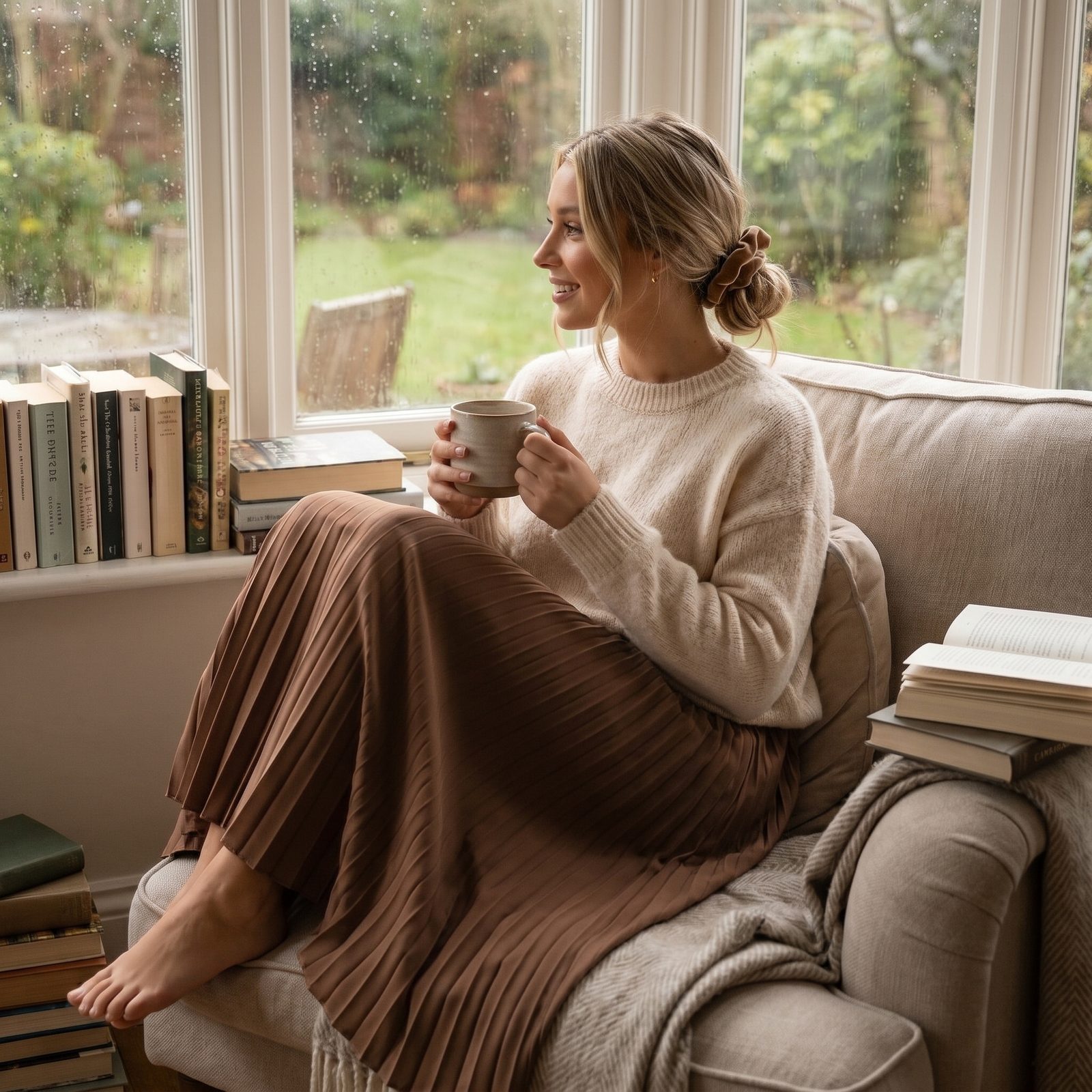
Mid-January is a strange little season inside the year. The excitement of a fresh start has cooled down to something quieter, and the days are still short, grey by half past four, darker still by five, and there's a particular quality to this time that I've started to appreciate rather than dread. It's less performative than January first. You're just in it now. The real work of the year, whatever it turns out to be.
I've been sitting with a phrase that keeps coming up for me lately: finally being at peace with yourself. I see it in conversations, in the corners of comment sections, in the things people say when they're describing what they're working towards. And I've been asking myself honestly: what does that actually mean in daily life? Not as a philosophical concept. Not as an arrival point on a timeline. What does it look like on a Tuesday in January when you're tired and the light is thin and the list of things that need doing is longer than the hours available?
I don't think I've arrived. I want to say that clearly. But I am somewhere different from where I was, even a few months ago, and I think it's worth documenting that, as honestly as I can, while I'm in it.
The areas where I've genuinely softened
There's an internal critic I've had for as long as I can remember. She used to be the loudest voice in the room. Any room. She had something to say about everything, how I handled a conversation, how long I slept, what I ate for lunch, whether I deserved to rest before the list was done. She was never satisfied. She moved the goalposts precisely when the goal was in reach.
She's quieter now. That's the most honest way I can put it. She hasn't gone, I don't think she ever completely goes, but something has changed in how much airtime she gets. I've learned, gradually and imperfectly, to hear her start and not immediately accept what she's saying as fact. There's a small gap now between the thought and the belief, and in that gap I can sometimes ask: is this actually true, or is this just the old script?
The comparison habit has also softened. Not disappeared, I'd be lying if I said social media never makes me feel a twinge of the familiar unworthiness spiral. But I've gotten better at noticing it early, before it becomes a whole afternoon's mood. I see the twinge, I name it, that's comparison, that's the algorithm doing its thing, and I try to redirect. Not always successfully. But more often than before.
And then there's rest. The need to justify rest, to have earned it, to have completed enough to deserve it, that one has loosened the most, I think. I sat on the couch last week on a Wednesday afternoon with a book and a cup of tea and I didn't move for ninety minutes. And somewhere in the middle of those ninety minutes I noticed I wasn't running a background calculation of what I was failing to do. I was just sitting. It felt almost radical. It felt like something I should tell someone about. Which is, I suppose, exactly what I'm doing.
The areas still in progress
I want to be careful not to write this as a triumphant arc, because it isn't one. The places I've softened are real. So are the places I haven't yet.
I still find it genuinely hard to receive criticism, even gentle, well-meant feedback, without a period of internal wincing that lasts longer than it should. I know the feedback is information. I know the person offering it usually means it kindly. I know my value doesn't live or die in someone else's assessment of my work. I know all of this. And still, there's a visceral first-response that feels like a small collapse, and it takes a while to rebuild.
I still lose whole afternoons to the particular anxiety that masquerades as productivity, the kind where you're doing many things in a scattered, slightly panicked way and nothing is getting properly done, and you know this, and you keep going anyway. The anxiety of stopping feels worse than the anxiety of moving. I'm working on this. Slowly.
I still sometimes treat my own needs as optional in a way I'd never accept from someone else. I'll skip eating properly because something else felt more urgent, or not go for the walk I'd planned because I talked myself out of it with the very convincing argument that I should be doing something more useful. This one I think is deep. It's going to take longer.
A slow January evening
Last Thursday I had the kind of evening that I'm starting to recognise as a marker of something shifting. It was about eight o'clock, and the flat was quiet, just the small sounds of the building around me, a bit of distant rain against the window. I was on the couch with a book that I'd been reading in small pieces across the whole of January, a mug of chamomile tea that I'd actually sat down to drink rather than leaving to go cold on the counter, and the little amber lamp on in the corner.
Nothing was happening. There were things I hadn't done that day. There were things I'd do tomorrow. But in that specific moment, with the warm weight of the book in my hands and the small circle of lamp-light and the rain, I noticed I wasn't anywhere else. I wasn't mentally at the to-do list, or the future, or the thing I'd said wrong in a conversation three days ago. I was just in the room. In the lamp-light. Drinking the tea while it was hot.
That might sound like a small thing. I think it is a small thing. But it's also a kind of test, the test of whether you can be in your own life without fighting it. And I'm passing that test more often than I used to. That's not nothing.
What peace actually is, from where I'm standing
I used to think peace was a state you arrived at and then maintained, something calm and still and permanent, like a lake on a windless morning. I don't think that anymore. I think peace is more like a practice you keep returning to, a direction you keep adjusting toward, a relationship with difficulty that keeps changing as the difficulty changes.
The thing I've learned, am still learning, is that peace is less about the absence of difficulty than about the quieting of the argument with difficulty. The difficulty will always be there in some form. The thing you're working on is your relationship with it: whether you meet it with a clenched-fist resistance or a more open-palmed acknowledgment that it is what it is, and you can work with it without it destroying you.
Finally being at peace with yourself doesn't mean you've resolved everything inside you. It means the argument is getting quieter. The internal noise is decreasing, however slowly. The critic gets less airtime. The comparison spiral catches you sooner. The rest no longer requires justification.
It means that on a slow January evening, with the rain on the window and the lamp in the corner and the book open on your lap, there's a moment, even a brief one, where the argument stops. Where you're not trying to be anywhere else or anyone different. Where the life you're in is just the life you're in, and that's okay.
Peace isn't the absence of difficulty, it's the quieting of the argument with difficulty.
Something I've been sitting with lately: the people I find most peaceful to be around are not the people who have resolved everything inside themselves. They're the people who have reduced the noise. Who have stopped performing certainty they don't have and stopped fighting with the realities they can't change. There's a looseness to them, a kind of settled quality that doesn't mean nothing is hard, just that they've made a working arrangement with difficulty.
I want that. I am, slowly, building some version of that. The internal critic is quieter. The comparison spiral catches sooner. The rest requires less justification. These are not dramatic developments. They won't make a good story for anyone else. But they're real, and they're cumulative, and on a slow January evening with the lamp on and the book open and the tea still warm, they're enough.
The work of becoming easier to live with, as yourself, is uncelebrated precisely because it's internal. Nobody hands you anything for it. There's no evidence visible from the outside. You just know, and only you know, that something has shifted. That you are a little less at war with your own existence than you used to be. That the argument is getting quieter, one January at a time.
That's where I am, mid-January. Not arrived. Just a little further along.