The spring birds arrived and I was actually watching this time
Last August I wrote a post about becoming a bird person. I want to follow up on that now that spring has arrived and I spent twenty minutes watching a goldfinch in a way that felt like something had gently closed in my chest.
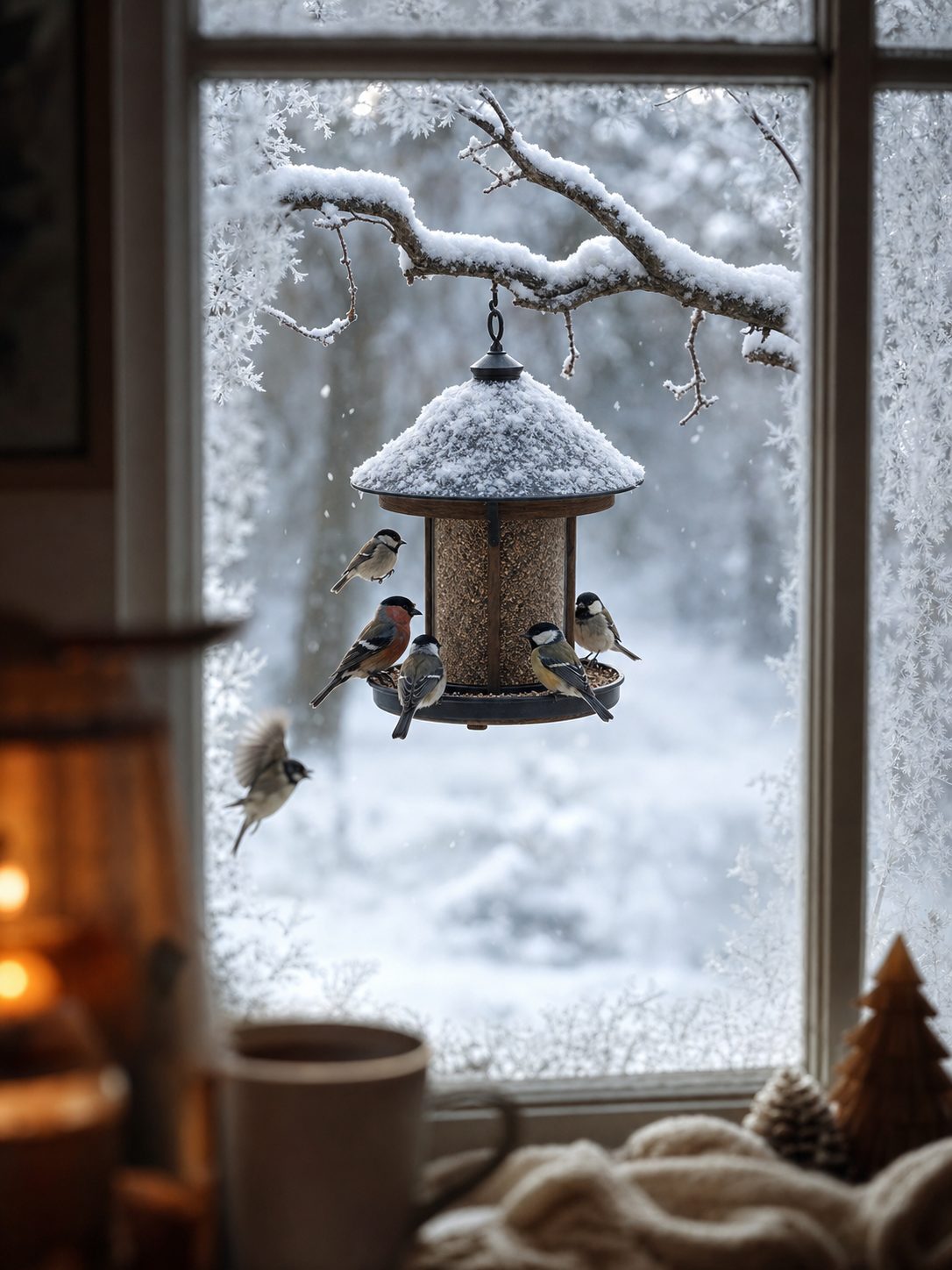
Last August I wrote a post about becoming, unexpectedly, a bird person. I'd been sitting by the window one morning with my tea when a goldfinch landed on the feeder outside and something in me went very quiet and very attentive, and I thought: oh. I think I want to know more about this. I bought a small identification guide that week. I started paying attention in a way I hadn't before. I wrote about it and felt slightly self-conscious about how enthusiastic I sounded.
I want to revisit that now. Because spring has arrived, the birds have come back, and something has genuinely changed since August, in what I know, in what I notice, in what birdwatching does for me. I spent twenty minutes this week watching a goldfinch at the feeder and felt a specific, complete happiness that I want to try to describe.
The callback: what's changed since August
When I wrote that first post I was a complete beginner. I could identify maybe four birds by sight, robin, blackbird, pigeon, sparrow, and none by sound. Everything else was just a small moving shape that I noted as "a bird" and moved on from. What I had was interest without vocabulary, which is a particular kind of wanting. You notice something but can't hold onto it because you don't yet have the words for it.
The guide I've been using is a small paperback one, slim enough to fit in a coat pocket, with watercolour-style illustrations that are actually beautiful to look at even when you're not trying to identify anything. I've been through it multiple times now. Folded corners on pages I keep returning to. A little pencil mark next to birds I've actually seen, a habit I developed somewhere around October when I realised it was giving me a record of the year.
By late autumn I could name about a dozen species reliably. By winter, maybe twenty, including some by sound. That progression happened so gradually I didn't notice it until a morning in February when I heard a sound outside, identified it without thinking as a song thrush, and realised with a small shock that I'd done that automatically. That I'd absorbed something. That kind of quiet learning, the kind that seeps in through repetition without you noticing, might be one of my favourite things.
The spring arrivals
There is a particular morning that marks spring for me now. Not the calendar date, not even the blossom, it's the morning I first hear the sound that tells me things have changed. This year it was a Tuesday in late March, grey and mild, and I was still in bed with the window cracked open when I heard it: a chiffchaff singing its own name from somewhere in the trees behind the garden fence. Two syllables, repeated. Chiff-chaff, chiff-chaff. One of the birds I can now name by sound.
I lay there and listened for several minutes without moving. The sound of a small migratory bird that has flown an enormous distance to be back in these trees, singing at dawn on a grey Tuesday, because spring says so. There is something about that which lands somewhere deep in me. The chiffchaff arrived. Winter was done.
Since then the garden has been filling up. The house sparrows who were regulars all winter are now louder, more chaotic. The blue tits are pairing up and being territorial. A blackcap arrived a week ago, I heard it before I saw it, a rich and complicated song from the hedge, and I found the page in my guide with the particular flutter in my chest that comes with a new identification. And the goldfinches. Always the goldfinches, back at the thistle feeder, their red faces and yellow wing-bars absolutely improbable in the morning light.
Standing at the garden fence in April morning light
There was a morning last week that I want to hold onto. Seven-thirty, maybe eight, the hour when the light is still low and angled, not yet flattened into midday. I'd taken my tea outside and was standing at the garden fence in a coat I probably didn't need but wore anyway because April mornings can still be cool and I like the excuse. The feeder was busy. Three or four sparrows, a pair of blue tits cycling off and back in their quick decisive way, a dunnock foraging low down underneath. And then the goldfinch landed.
I have seen goldfinches many times now. I know what they look like. I know the sound they make, a liquid, bubbling call that seems too cheerful for early morning, like someone laughing. And yet I still stop. I went completely still at the fence with my tea held in both hands and I watched. The goldfinch on the thistle, that particular bright red of its face, the yellow flash of its wing that only appears in motion, the way it works through a seedhead with a neatness that is almost surgical. The sounds overlapping around it. The sparrows arguing. The blue tit somewhere above me giving its sharp alarm call. The dunnock's quiet shuffling. And under all of it, the goldfinch, doing its precise and brilliant thing.
I don't know how long I stood there. Long enough for my tea to go from hot to merely warm. What I know is that there was nothing in my head during those minutes except the birds. No scrolling mind, no tomorrow's list, no background static. Just the garden, fully present in it, the feeder and the fence and the morning light and this particular cluster of small lives going about their morning as if I weren't watching.
Twenty minutes of birdwatching gives me back something that an hour of other things can't. It's not rest exactly, it's more like calibration.
What it still does for me
People sometimes ask what the appeal is, and I find it genuinely hard to explain in a way that doesn't sound slightly absurd. The focus it requires. That's part of it, birdwatching demands that you be very quiet and very still and pay attention in a specific direction, which turns out to be the opposite of what my phone asks of me. My phone asks me to divide and scatter my attention across thirty things at once. A bird at a feeder asks me to be here, now, and not blink.
There's also the patience it's taught me. You can't rush it. You can stand at that fence for twenty minutes and see nothing remarkable, and that's fine, the standing is the practice, not just the sighting. I've become a more patient person this year and I think birdwatching has had something to do with that. The willingness to be still and wait without guarantee. That is a skill that transfers.
And then there's the grounding of it. The knowledge that spring returns. That the chiffchaff will come back and sing its own name from the trees. That the goldfinch is on the thistle feeder right now, doing its precise and cheerful work, regardless of whatever I'm anxious about this week. There's something about being reminded that the natural world is ticking along in its own time, at its own scale, that is genuinely stabilising.
Slow hobbies and what they give you
I've been thinking about this a lot lately, the particular value of hobbies that unfold slowly. Art journaling is like this too. Things that require sustained, low-pressure attention over months, where the reward isn't immediate and the learning is cumulative and you don't always know what you've absorbed until you suddenly know a bird by sound without looking it up.
I started birdwatching because a goldfinch landed on my feeder in August and something made me pay attention. That's all it was. Eight months later I have a pencil-marked guide and a small vocabulary of sounds and the kind of settled enthusiasm for a thing that only comes from having genuinely stuck with it. The chiffchaff came back. I was actually watching this time. I knew what I was listening for.
Slow hobbies deepen rather than exhaust you. I believe this more every month. The things that ask you to be patient and present and unconcerned with progress, they're not less rewarding for being unhurried. They might be more so.
A small guide and three sounds
I want to give the little birdwatching guide its credit because I've been using it for eight months now and I think it's been one of the most useful small objects in my life during that time. It's compact enough to fit in a coat pocket. The illustrations are painted, not photographic, which I prefer, there's something about a painted illustration that shows you what to look for in a way a photograph doesn't always do. The photographs are accurate; the paintings have a kind of emphasis built into them, the important features highlighted by the choice to include them.
The three birds I can now name by sound: the chiffchaff, which I've already described. The great tit, a loud, swinging two-note call that sounds like a very determined squeaky gate; once you've heard it you hear it constantly and wonder how you didn't notice it before. And the robin, the autumn and winter robin, specifically, which has a particular quality of melancholy to it at dusk, a thin, trailing sweetness that sounds like it knows the light is going. The spring robin is bolder, more declarative. I love them both.
Identifying a bird by sound before you see it is one of the small specific pleasures of this hobby. The information comes before the confirmation. You hear the chiffchaff, you think: that's a chiffchaff, and then you scan the branches until you find it, the small brown-green shape in the budding tree, doing its metronomic two-note thing, completely indifferent to being observed. The seeing is a kind of proof. But the hearing was the knowledge. I like that order.
I'm working on warblers. They are difficult. The difference between a willow warbler and a chiffchaff is clear once someone explains it to you, the willow warbler descends, the chiffchaff alternates, but in practice, at half seven on a spring morning with everything else going on, my ear isn't yet reliable. I'm getting there. The guide has the relevant pages slightly more dog-eared than the others. I'll know them by summer. 🤍