The strange peace I found in watching birds
It started because I couldn't sleep one morning and I ended up at the window. There was a tiny bird on the feeder I'd hung up months ago and forgotten about. I stood there for forty minutes. I want to tell you about that.
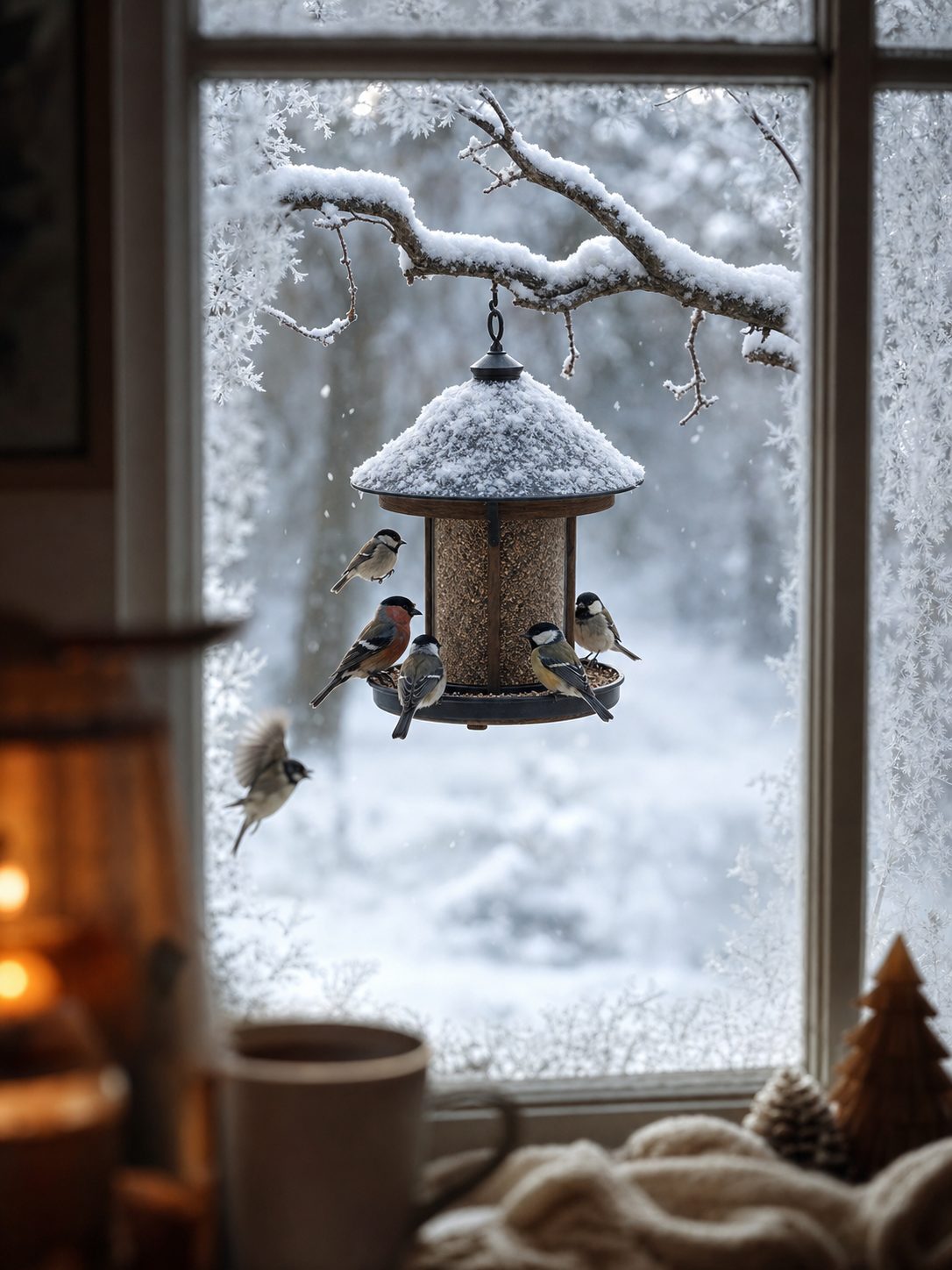
I want to be upfront about something: I did not think I was a bird person. The phrase "bird person" conjured for me a very specific image, binoculars, a waterproof jacket with too many pockets, an intimidating knowledge of habitats, and I am not that person. I am a person who films things in her flat and drinks too much tea and sometimes forgets to open the curtains until noon. These did not seem like compatible identities.
And yet here we are. Here I am, eight months after hanging a small bird feeder outside my kitchen window almost as an afterthought, writing about the specific quality of peace I've found in standing very still and watching small creatures eat seeds. BirdWatching, it turns out, has nothing to do with binoculars. It has everything to do with learning to be where you are.
The feeder I hung up and immediately forgot about
It was a late-night purchase, the kind you make when you've had a few weeks of feeling cooped up and the idea of bringing something live and wild and small into your peripheral view feels genuinely appealing. It arrived in a small box and I hung it from the hook outside the kitchen window the same afternoon, filled it with seed mix from the supermarket, and felt briefly pleased with myself.
Then nothing happened for six weeks. The feeder hung there, full, undisturbed. I walked past it in the mornings without looking. I assumed the local birds had noted it and simply decided, collectively, that they didn't want it, that they had better options, that they were brand-loyal to a different feeder two gardens over.
The morning it changed, I was in one of those half-awake states, maybe five in the morning, mind already busy with things it had no business being busy about at that hour. I ended up at the kitchen window, not quite sure how I'd got there, with the grey pre-dawn light coming in and the street outside still completely quiet. And there, on the feeder I'd forgotten about, was a small bird. Then two. Then three. Working at the seeds with absolute concentrated purpose, completely unaware of me on the other side of the glass.
I stood there for forty minutes. I didn't decide to. I just didn't leave.
What birdwatching actually asks of you
It asks for stillness. Not the kind that feels like deprivation, like the stillness of trying to meditate and thinking about your grocery list. Real stillness. The kind that comes when something is happening outside yourself that is interesting enough to draw your full attention outward.
This is, I think, the mechanism. Your attention goes out, toward the birds, toward whatever they're doing, and in going out it stops turning inward on all the things it usually chews on. You can't spiral when you're watching a blue tit try to figure out a feeder. The problem-solving behaviour is too compelling. The small drama of the bird on the left trying to displace the bird on the right is too immediate. Your nervous system is occupied, and it is occupied pleasantly, with something that is happening right now and only right now.
It is, and I say this with full awareness of how it sounds, one of the most effective forms of presence I've found. More than my attempts at formal meditation, more than the apps, more than the breathing exercises that I do correctly and then immediately worry about whether I'm doing correctly. Just: stand at the window, watch the birds, be here.
The birds I can now name
I am quietly proud of this small list. Six months ago I would have said "a bird." I now know better:
- Blue tits, the most frequent visitors, small and bold and extraordinarily pretty in the right light, their blue-yellow colouring almost absurdly vivid.
- Great tits, bigger, bossier, with that distinctive black stripe down a yellow chest that looks like they've been dressed for a formal occasion they're too confident to be nervous about.
- House sparrows, in gangs, chatty, not particularly glamorous but endearing in their sociability.
- A single robin, who comes alone, early, and seems to consider the feeder a personal resource rather than a community one.
I have not moved to binoculars. I am not there yet. But I did download an identification app after the second week, and I have used it more times than I would have predicted. There is a particular satisfaction in knowing the name of a thing you're looking at. It deepens the relationship somehow.
Standing at the window in the early light
My favourite version of this is on a Wednesday. I don't know why Wednesday specifically, it might just be that by midweek I need it most. I'll wake early, earlier than I mean to, and instead of lying there trying to go back to sleep I'll put on the kettle and stand at the kitchen window with the warm mug held in both hands, the steam rising slightly, watching the feeder.
It's always cool in the mornings now, even in August, the light comes in flat and grey-white before the sun gets itself properly organised, and the garden is very quiet. The blue tit is almost always the first arrival, always from the same direction, always landing with the same light precise confidence. I've started to feel a small irrational fondness for this particular bird, I know it's probably not the same one every time, but it feels like continuity. It feels like having a regular at your local, someone you can count on to show up.
There's a quality to this twenty minutes that I can't quite describe and have stopped trying to. It isn't dramatic. Nobody is learning anything. Nothing is being produced. And yet it does something to the quality of my day that the first cup of tea alone doesn't manage, grounds it, somehow. Reminds me, without words, that there is a world outside the notifications and the to-do list and the half-finished video on my hard drive, and that the world is doing fine and doesn't need me to worry about it.
The meditative quality of noticing
I've come to think of birdwatching as a particular kind of noticing practice. You're not trying to notice yourself, which is where most mindfulness practices want you to go, and which I find genuinely difficult because the self is a very noisy thing to try to observe neutrally. You're noticing outside things. The behaviour of the birds. The order in which they arrive. The way the light changes as the morning warms up. The particular sound pattern of a robin versus the general cheerful chaos of the sparrow group.
And noticing outside things quiets the inside ones. This is not a theory I have about it, it's an observation from direct experience, repeated enough times now that I'd stake something on it. When I've spent fifteen minutes at the window in the morning, the first hour of work goes differently. My thoughts are slightly less tangled. My tolerance for the ordinary friction of the day is slightly higher. Something has been reset that tends to get stuck.
Slow hobbies are portals to the present moment. They work by making the present moment more interesting than the ones your anxiety keeps projecting.
I didn't expect birdwatching to become part of my life. I hung that feeder on a whim and forgot about it. But something about that blue tit on that grey morning found something in me that needed exactly this, a reason to stand still, look outward, and let the inside noise have a rest.
If you've been thinking about a feeder, or a garden, or any slow hobby you've been slightly dismissing as not for you, I'd gently say: it might be more for you than you know yet. The unfamiliar doesn't mean wrong. Sometimes it means exactly right, just six weeks before you've realised it.
I've started telling people about the birds in a slightly self-conscious way, because I'm aware that "I've been watching birds" is a sentence that sounds different at different ages and I am twenty-something in a rented flat, not a retired person with a garden and a dedicated bird bath, and the image doesn't quite cohere. But the people I've told who've tried it have come back to say something similar every time: I didn't know I needed to stand still that much.
There's something to that. We don't know we need things until we accidentally do them. I hung the feeder as a vague, impulse-driven gesture toward having something alive and interesting in my field of vision while I made breakfast. I didn't know I was creating a morning practice. I didn't know the specific quality of calm that would follow from forty minutes of watching small creatures go about their bird business. You can't know those things in advance. You can only put the feeder up and forget about it and then stand there on a grey morning in August with both hands around your mug and let whatever is going to happen, happen.
The robin came back yesterday. Alone, as usual, in the early part of the morning before the sparrows arrive and complicate the social dynamics. I watched it for a while from the kitchen, the overhead light still off, the flat quiet around me. The robin is not interested in being watched. It is interested in the feeder, and the particular seeds it considers worth the effort, and in asserting that this territory is its territory. It does this with great confidence and no self-consciousness, which I find, genuinely, inspiring. 🤍