The strange, specific person I've turned out to be, and I'm fine with it
Here is a partial list of things I am: someone who photographs mugs before drinking from them, who knows the exact order birds appear at the feeder, who reads the same paragraph three times when it's very good. This is a celebration of that.
Here is a partial list of things I am. I photograph mugs before I drink from them, not always, but often, when the light is right and the mug is the right shape and the steam is doing something interesting. I know the exact order birds arrive at the feeder on the windowsill opposite, and if the sequence breaks I notice it before I register anything else that morning. I read the same paragraph three times when it's very good, not to understand it better, but because reading it once doesn't feel like enough, the way eating one really good piece of bread doesn't feel like enough. I care about what kind of light I work in. I have a preferred corner of the sofa and I feel a small but distinct unhappiness when I sit somewhere else. I keep a list in my paper journal of things that made me feel something, and the things on it are almost never significant events.
This is a celebration of all of that. It took me longer than it should have to get here.
How long I spent finding these things embarrassing
The answer is: most of my life up until fairly recently. I had this persistent belief, absorbed rather than decided, the worst kind, that the specific things you care about are the things that make you look small. That caring too particularly about mug photography or bird-arrival sequences or the precise corner of a sofa was somehow excessive. Overthinking. Too much. The socially safe version of a person cares about things in a general way: they like nature, they enjoy good food, they're into reading. The generic version is defensible. The specific version is vulnerable.
Vulnerable is the right word. When you say I like reading, nobody can touch it. When you say I re-read the same paragraph three times when it's very good because once isn't enough, you've handed someone something that is entirely yours and could theoretically be laughed at. For years I preferred the safety of the general. I edited out the particular.
I don't know exactly when that changed. It was gradual, and it was connected to this diary in ways I'm only just beginning to understand. But I know it changed. And I know that the changed version of my life is better in every way that matters.
The specific inventory
Let me go further, because the celebration is more complete with the details in. I am someone who pauses music mid-song and goes back forty seconds to hear something again. I fold the corners of recipe pages in cookbooks even though I also use digital bookmarks, the physical crease feels more committed somehow. I have strong opinions about the placement of furniture that I almost never mention but that I'm definitely always having. I notice when the supermarket has rearranged an aisle and it bothers me more than it should. I get genuinely moved by the quality of light in an ordinary room at an ordinary time of day.
I am also someone who, if left completely to her own preferences for a whole day, will probably: make tea four times and finish none of them fully, spend forty minutes looking at something small in the garden, rearrange at least one corner of the flat, open three books and read a chapter of each rather than one book fully, and end the day with the strong feeling that it was a good day. This is my honest version of a good day. It took me years to stop calling it a wasted day.
The phrase be weird, be random, be who you are sounds simple. It is simple. The difficulty is that for most of my life I was doing the opposite without realising it, editing the weirdness out, smoothing the specific into the general, performing the version of myself that I calculated would be most broadly acceptable. The editing is exhausting. The specific person underneath is not.
What the creator discovery taught me
When I started posting, the videos, the blog, this soft little diary, I made a decision fairly early on that I would try to be specific. Not personal in a dramatic way, but specific in the way of: name the mug, describe the bird, explain about re-reading the paragraph. Say the actual thing rather than the rounded-off version of it.
The response to that specificity was the most surprising part of the whole year. The specific things, the things I'd been editing out for years because they seemed too particular, too small, too much, were exactly the things that brought people in. Not everyone. But the right people. The ones who also photograph their mugs before drinking from them, or who have a preferred corner, or who find themselves genuinely moved by the quality of afternoon light on a familiar wall.
There is no generic audience for specific things. But there is a very particular audience, and they are looking for you. They're looking for the exact version of the weirdness that matches their own weirdness. And you can only find each other if you're both willing to be the specific one rather than the safe general version.
That realisation changed how I make everything. It made me braver about the details. It made unfamiliar doesn't mean wrong feel true in a new way, not just about habits and routines but about the whole shape of your personality. The things about you that feel unusual are probably exactly the things that somebody, somewhere, is desperately looking for.
The wildflower field in May
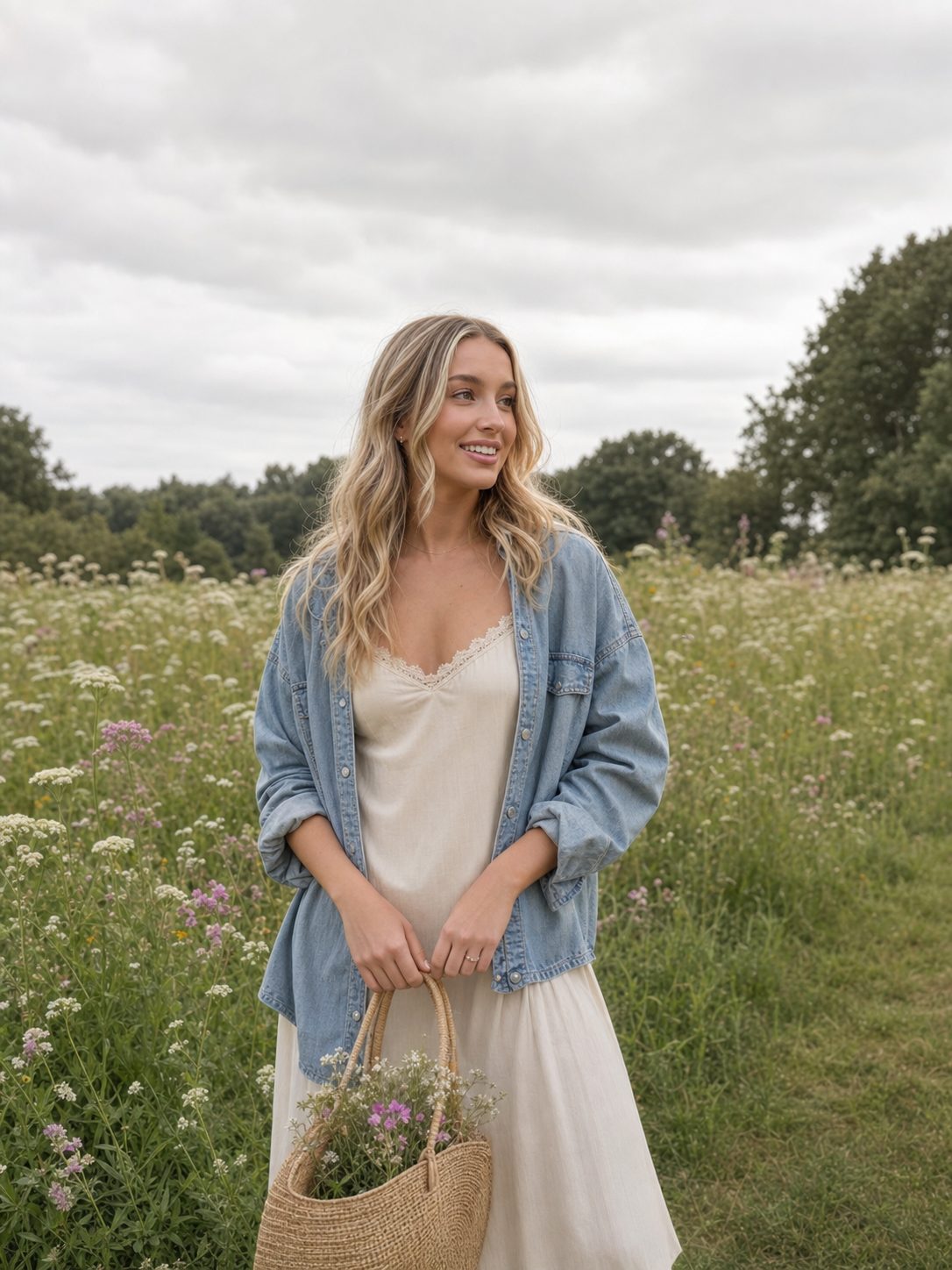
Yesterday evening I was at the edge of the wildflower field, the one that goes completely wild at this time of year, all those tall grasses and the white flowers and the occasional burst of purple I never remember the name of. The light was going soft and golden, that particular end-of-day quality that happens in May when the sky is clear and the sun is getting low. I was there alone. No performance, no content, no awareness of being seen. Just me at the edge of the field.
And I noticed things. The specific things I always notice. The way the light caught one section of the grass and turned it almost copper. The sound of something moving in the far end of the field that I couldn't identify. The smell of something warm in the air, grasses warming up and releasing, I think, but I'm not entirely sure. I stood there and I registered all of it and felt the specific form of happiness that I get from being completely myself in a moment that requires nothing from me.
The world was not requiring me to be anything other than what I am. Just the strange, specific person I've turned out to be, at the edge of a wildflower field, noticing things.
What I'd tell the version of me who was still editing
You were never meant to be the generic version, and the specific things you've been editing out are the most interesting things about you. Start putting them back in.
I'd tell her that the editing doesn't protect you from being laughed at, it just guarantees you'll never be truly found. That the people who would laugh at the mug photography or the paragraph re-reading were never going to be your people anyway. That the cost of being specific is vulnerability, and the reward is belonging, actual belonging, to the small group of people who love the exact version of you that exists, not the general version that's safe.
I'd tell her that the weirdness is the point. That the strange particular inventory of your specific self is not a liability. It's the whole offer.
- The mug photography stays.
- The bird-arrival sequence stays.
- The paragraph re-reading stays.
- All of it stays.
You were never meant to be the smoothed-out version. You were meant to be the one who knows where the birds arrive in order, who feels moved by light on an ordinary wall, who stands at the edge of a wildflower field noticing things that most people walk past. That person is not too much. That person is exactly enough. And there are people out there who have been looking for exactly her.
The things you stop apologising for
Here's one more thing I've noticed, which is that over the course of a year of leaning into the specific rather than editing it down, you start to stop apologising for it. Not dramatically, it's not a speech you give. It's quieter than that. It's just that the reflexive pre-apology, the one that used to arrive before almost any admission of a particular interest or preference, starts to arrive less often. You say the thing about re-reading the paragraph and you don't follow it with I know, I know, it's a lot. You just say it and let it be said.
That absence of the pre-apology has been one of the most liberating small changes of the year. Because the apology was never really about the specific thing, it was about the belief underneath that the specific things needed apologising for. And when the belief shifts, when you start to genuinely believe that the particular is interesting and not excessive, the apology just … stops generating itself. There's nothing to apologise for.
I'm still working on this in some areas, if I'm honest. The places where I do it less naturally are the ones where I feel most exposed, the deeper preferences, the things that aren't quirky and endearing but just quietly mine in a way that feels more private. But even in those areas, the shift is happening. Slowly. In the way that all the real changes in this soft little diary have happened: not all at once, not as a decision, but as a gradual, gentle loosening of something that was held too tight for too long.
Be weird. Be random. Be who you are. I've been working on taking that seriously for a year now and the evidence is in: it works. Not in a performance sense, not in a follower-count sense, though those are fine too. It works in the actual daily sense. The sense of moving through your own life as the real version of yourself rather than the carefully edited version. That particular freedom, the freedom of your own specificity, is the quietest and most profound one I've found. 🤍