The lamp that changed my whole bedroom
I spent months staring at my bedroom ceiling at night, vaguely unhappy with the space but unable to name why. Then I changed the lamp. I know.
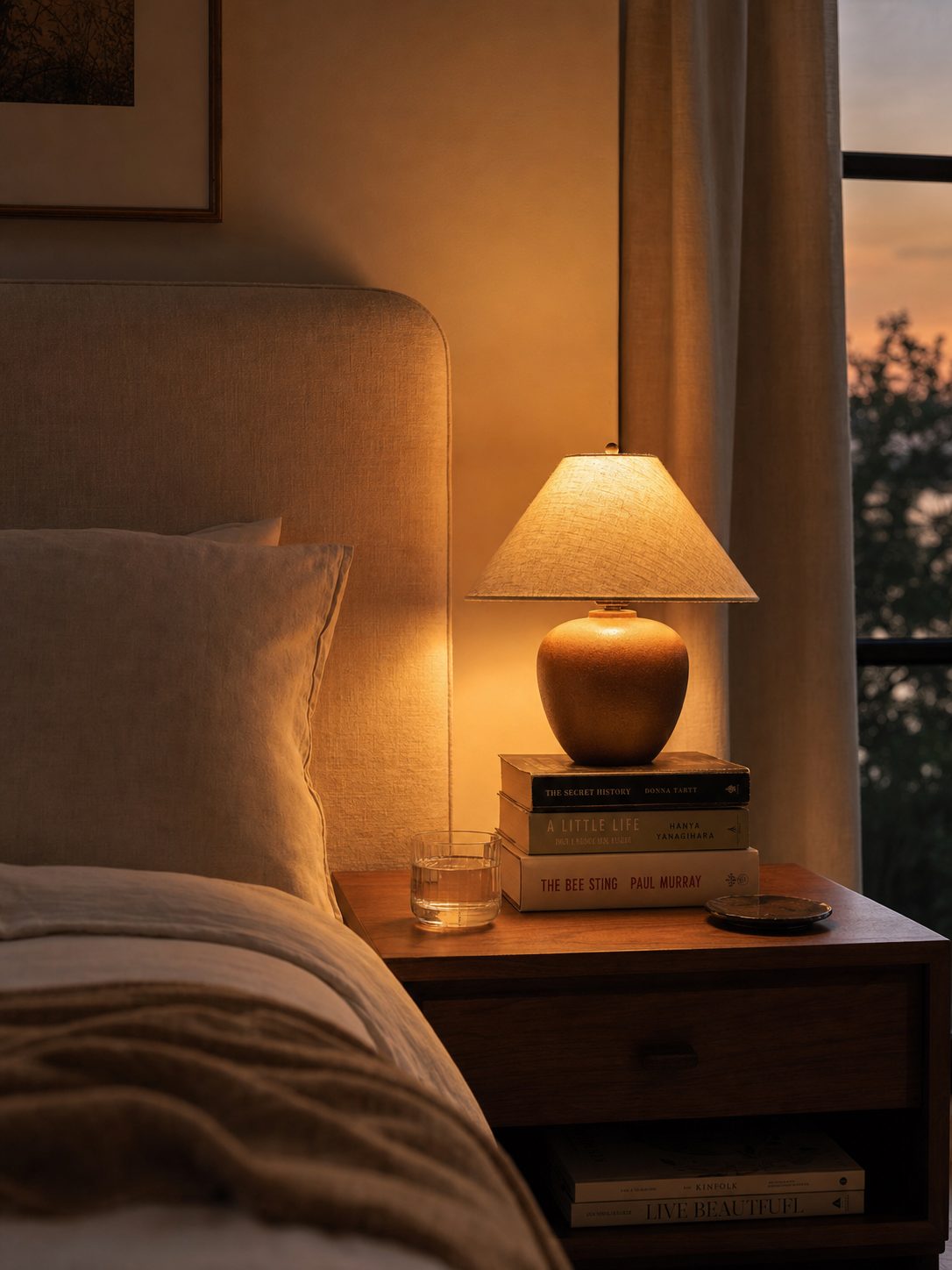
For most of this year, I have been lying in bed at night feeling vaguely, persistently wrong about my room. Not unhappy, just off, somehow. Like a note played in almost the right key. The duvet was comfortable, the pillows were fine, I'd even finally bought a proper headboard that I was proud of, and still, every night, there was this faint discomfort I couldn't locate.
It took me until March to figure out what it was. And when I did, I felt a little ridiculous about it, because the answer was extremely obvious in retrospect: the light.
I had one light in my bedroom. One single overhead light, a standard fitting with a flat round shade that cast bright, flat, even illumination across every surface. The kind of light that is perfectly adequate for finding your keys. Absolutely wrong for winding down at the end of a long day. Under that light, my brain had no way of knowing whether it was 2pm or 11pm. It was just bright. Relentlessly, evenly, efficiently bright. And I'd been wondering why I couldn't relax.
The search, and what I was actually looking for
I started where everyone starts: an online scroll, vague and slightly directionless. I typed things like "bedside lamp warm glow" and "cozy bedroom lighting" and "warm and cozy home setup bedroom." I went down a rabbit hole of linen lampshades and ceramic bases and rattan table lamps and vintage-style filament bulbs and after approximately forty-five minutes I was significantly more confused than when I started.
The problem was that I thought I was shopping for aesthetics. I spent a long time looking at lamps that would look nice, that would photograph well, sit elegantly on a nightstand, complement the cream headboard. What I was actually looking for, without quite knowing it, was light temperature. The simple, physical, measurable warmth of the light coming out of the thing.
This is the part where someone who knows about lighting would nod patiently: kelvin. Colour temperature. The overhead light I'd been living under was somewhere around 4000K, cool, clean, clinical white. What you want in a bedroom, particularly at night, is closer to 2200-2700K. Warm amber. The colour of firelight, of late afternoon sun, of candlelight. The colour that tells your nervous system: it's evening, it's safe, you can start to come down now.
I found a small lamp in a shape I liked, a simple mushroom-curve thing, not too tall, with a warm linen-look shade, and I ordered a bulb separately, a filament-style one rated at about 2400K. The whole thing cost less than I expected and arrived in three days. I put it on my nightstand, threaded in the bulb, and turned it on for the first time at around nine in the evening.
The first night with it on
I sat on the edge of my bed and stared at the room and felt, genuinely, like I was somewhere else.
The amber glow of it was, I keep reaching for words and coming up short, which is funny because it's just a light, it's photons, it's nothing, but it felt like the room finally exhaled. The cream duvet looked the way cream things look in photographs. The white wall behind the lamp went a warm vanilla-gold. The stack of books on my nightstand, which I'd been stepping over for two months without really seeing, suddenly looked intentional. Cosy. Like a choice.
I lay back and looked at the ceiling, which was now a warm, low-lit, utterly unoppressive ceiling instead of a bright glaring one, and I noticed that my jaw was unclenched. My shoulders were lower. My whole body had received some kind of message I hadn't consciously sent it, something like: this is okay, this is restful, we don't have to stay alert here.
Ambient light is one of the cheapest forms of interior design, and also the most overlooked.
I don't think I fully grasped before that night how much the quality of light in a space communicates something to us on a level below conscious thought. We talk about interior design as if it's about furniture and colour palettes and whether your cushions coordinate. But light, the warmth of it, the direction of it, how many sources there are and where they sit, that's doing work that no cushion can do.

The other small changes that helped
Once I'd felt the difference the bedside lamp made, I became slightly obsessed with the idea of fixing every other light situation in my flat. Not in an expensive, rip-everything-out way, more of a low-stakes, cheap-tweaks way.
The first thing was a small clip light for reading. I'd been using the bedside lamp for reading, which was fine, but the angle was slightly wrong, the light came from the side and cast shadows across the page in a way that made my eyes work harder than they needed to. The clip light attaches to the headboard and points directly at the book. It sounds very small. It made a real difference.
The second was a candle on the dresser. Not for ambiance in a performative, Instagram-bathroom way, just a real beeswax pillar candle that I burn for about an hour before bed. The light of a single candle at a distance does something to a room that even the warmest lamp can't fully replicate, because candlelight moves. It's not static. Something in us responds to it differently. I'd read that somewhere vaguely and mostly dismissed it, but after a week of the candle in the evenings I was convinced. My whole wind-down felt different.
- One warm bedside lamp, ideally under 2700K, positioned at shoulder height or below.
- A clip reading light if you read in bed, kind to your eyes and your partner's if you have one.
- A candle on the dresser for the last hour before sleep if you're into that kind of thing.
- A dimmer switch if you can manage it, the ability to control brightness by time of evening is transformative.
I don't have a dimmer switch yet. It's on the list, along with the dog I keep thinking about getting and the drawer organiser I keep telling myself I'll buy. But the lamp and the candle, I have, and they've been in rotation ever since.
The thing I learned that surprised me
I spent quite a lot of time in my flat last year feeling like it didn't quite feel like a home. It was small, studio-flat-adjacent, the kind of place where the living space and the sleeping space share more of a vibe than strictly ideal, and I had a creeping sense that no matter what I did to it, it was always going to feel temporary. Transitional. A place I was waiting to leave rather than somewhere I was actually living.
The interior design content I'd been absorbing online, the beautiful curated rooms, the linen and the reclaimed wood and the considered clusters of objects, always seemed to require a level of either money or permanence I didn't have. And so I'd been living in a kind of ambient resignation: this is fine, it's just a flat, I'll make it nice when I have somewhere better to do it in.
What I didn't understand, what the lamp taught me, in its low-key way, is that ambient light is one of the cheapest and most powerful tools available for making a space feel like yours. Not the furniture. Not the artwork. Not the carefully sourced ceramics I kept bookmarking and not buying. The light. The quality and temperature of the light when you're in the space in the evening, unwinding, just being. That's what communicates something to your nervous system. That's what makes a room feel like it's working with you or against you.
A lamp fixed more of that feeling than I expected it to. Not all of it, but more. Because a warm and cozy home environment, it turns out, is less about the size or the fixtures or the furniture you can or can't afford, and more about what the light communicates at nine in the evening when you're just you, no plans, no obligations, just sitting in your own space.
If you have one thing to change in a room that isn't quite feeling right, my honest suggestion is: start with the light. Before the cushions. Before the plants. Before the tasteful print you've been looking at for three months. Just change the light. Turn off the overhead. Put a warm lamp in the corner. Sit with it for an evening and let your nervous system figure out that it can relax now. It might surprise you how much space that small thing makes.
It communicates: this is your place. This is a good place to be. You did okay today. Rest now.
That's what I wanted from the bedroom, I think. I just didn't know it was the lamp I was looking for. 🤍