The visual diary trend that finally made sense to me
There's a difference between taking a photo to post and taking a photo because you want to remember something. When I started thinking about my content through the second lens, everything got easier.
There's a difference between taking a photo to post and taking a photo because you want to remember something. I understood this intellectually for a long time before I understood it in practice, before I actually felt the difference in my body, in the way I held the phone, in whether my jaw was tight or relaxed.
When I started thinking about my content through the second lens, everything got quieter. Not just easier, quieter. Less noise in my head about whether something was good enough, whether it would perform, whether I'd cropped it right or the light was soft enough. Just: I want to keep this. That was enough.
The TikTok photo dump trend is not a new thing, but it found me at the right moment. Or rather, I found it, I'd been watching people post these loose, unpolished little grids of moments and feeling something unclench in my chest every time. The blurry one. The accidental one. The one that's just a cup and a window and no particular intention. I kept watching them and thinking: that looks like relief.
What the photo dump trend actually gave me
I think what draws me to the visual diary format, beyond the obvious aesthetics, is that it's explicitly imperfect by design. A photo dump isn't a curated portfolio. It's not trying to be a gallery. It's a handful of moments from a period of time, held loosely together by the fact that they all happened to the same person in roughly the same stretch of days.
That framing changed something for me. Because when I'm making a photo dump rather than a content piece, I'm not asking: is this good enough to show? I'm asking: is this something I want to hold onto? And those are completely different questions that produce completely different feelings.
The pressure that lifts when I take a photo for memory rather than for content is hard to overstate. There's a whole internal committee that gets convened when I'm making content, composition, caption, timing, relevance, whether this fits the aesthetic I've been building, whether it'll get buried by the algorithm, whether anyone will even care. That committee is exhausting. When I take a photo for my own archive, that committee doesn't get a seat at the table. It's just me and the thing in front of me.
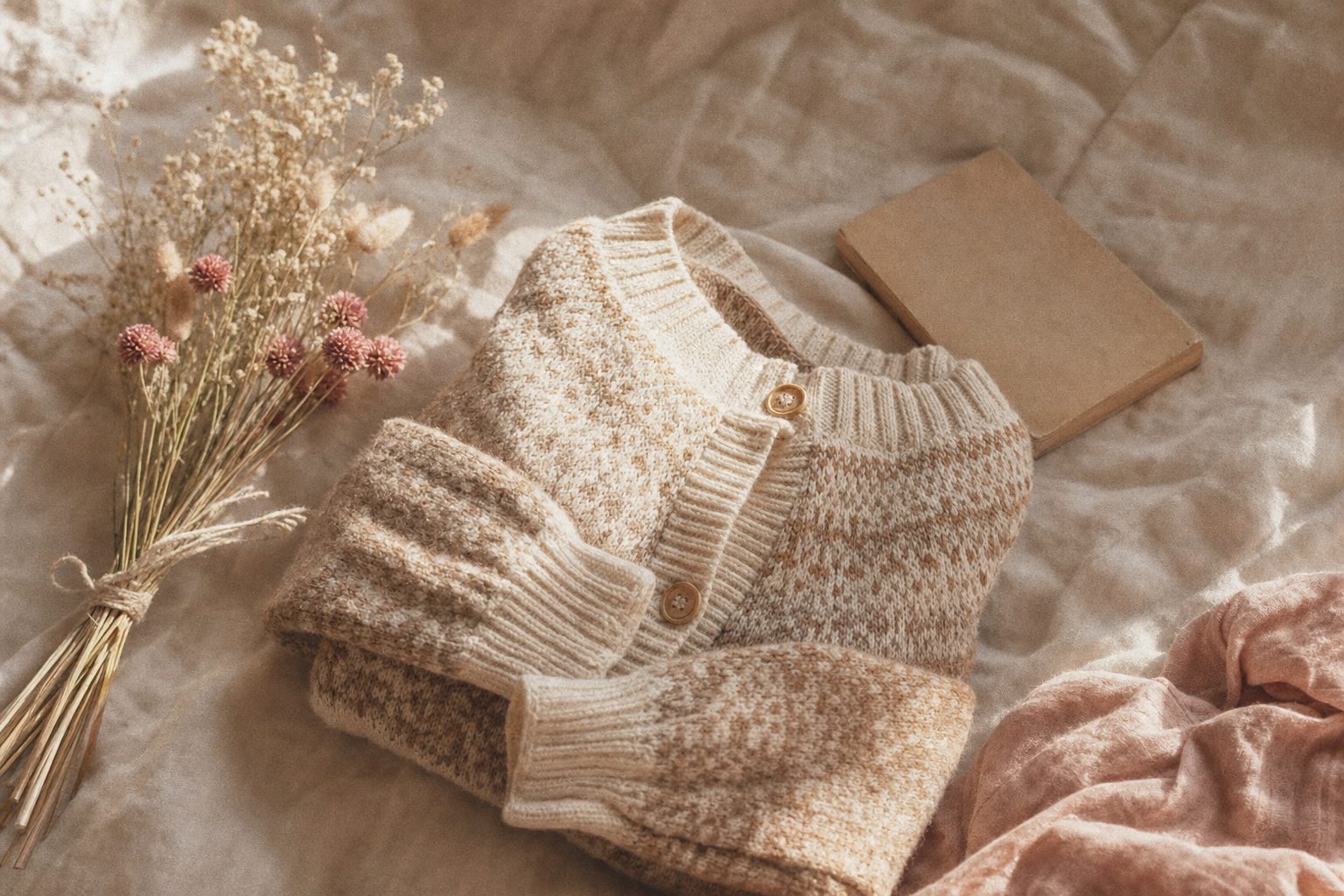
I started noticing this distinction clearly one Sunday afternoon in late August. I'd folded a cream knit cardigan, one I'd pulled out for the first time since last October because the evenings were finally starting to cool, and laid it on my bed next to a vase of dried flowers I'd had on the windowsill all summer. The light was doing something gorgeous: that thick golden-hour thing that happens in August just before it tips into September. I picked up my phone.
The folder I keep just for myself
I wasn't thinking about posting it. I just wanted to keep it. The cardigan, the dried flowers, that particular quality of August-nearly-September light that is different from any other light all year, warmer, more amber, more aware of its own ending. I took four or five photos. One of them was really beautiful. I put it in a folder on my phone that I've called, with very little imagination, "just mine."
That folder has maybe two hundred photos in it now. They're not all beautiful. Some of them are dark and slightly blurry. There's one that's just my hand around a mug, the rest of the frame out of focus, but I took it on a morning that felt important somehow and I know exactly which morning it was when I look at it. That's what a memory anchor does, it doesn't need to be technically good. It just needs to be true.
The TikTok photo trends that resonate most with me are always the ones that lean into this, the visual diary style of content that feels like someone just showed you their phone roll, unfiltered. The slightly odd compositions. The mundane things elevated by having been noticed at all. That noticing is the whole point.
How certain photos become anchors
I've been thinking about why some photos become anchors to whole periods of life and others, even technically better ones, just disappear. I think it comes down to whether you were actually present when you took them.
The photos I return to again and again, the ones that immediately put me back inside a specific hour, tend to be ones I took without overthinking. The ones that came from a moment of genuine wanting-to-keep. And the photos I scroll past, even some of my most performed, most optimised content images, feel strangely empty when I look back at them. Pretty, yes. But present? Not really. I was thinking about the post, not the moment.
This isn't a condemnation of making content. I still do it, I still enjoy it, it's part of what I'm building here. But I've started thinking of content and memory as two different modes that I need to consciously switch between. When I'm filming or shooting for content, I'm in production mode. When I want to archive something for myself, I put the content brain away entirely.
The separation has made both things better. My content brain is more focused and less precious when it has its own space. My memory brain is more relaxed and more present because it doesn't have to perform for anyone.
- The folder on my phone that's just for me, no pressure, no audience.
- The blurry photo I keep anyway because it captures the feeling exactly.
- The cardigan in late summer light that I photographed before I'd decided to post anything at all.
What I've learned about creating from memory first
Something I didn't expect: the photos I take for myself often become the best content. Not immediately, sometimes weeks later, when I look back through the "just mine" folder and find something that feels genuinely alive in a way that my planned content doesn't always. I pull it out and write a caption from the same place I was in when I took it, present, unhurried, just trying to keep something real, and those posts seem to land differently.
The best content I've made started as something I was making for myself, without an audience in mind at all.
I think people can feel the difference. I think they can feel when you were actually there, in the moment you're sharing, versus when you were thinking about the moment as something to share. The former has a texture to it. A kind of warmth or specific detail that manufactured content rarely achieves. You can't fake having been present. You can try, and sometimes it almost works, but mostly it doesn't.
I've been building my visual diary slowly, as an ongoing practice rather than a project with a goal. The folder grows. The cardigan photo is in there, next to a close-up of my journal page from a Tuesday morning in July, next to a slightly blurry image of the rain on my window from an afternoon when I had the lamp on and it felt particularly cozy inside. Next to a photo of my tea going cold that I took because I always let my tea go cold and it felt like the most accurate portrait of me that existed.
None of those photos are going to win anything. But they're mine in a way that my most polished content rarely is. And there's something in that, something I want to keep protecting, even as the creator side of my life grows.
We're approaching September now. The light is already starting to change, tilting into something more amber and slanted. I'll keep photographing it for myself first, and letting the content come second if it comes at all. That order feels right. That order feels like the version of this I can sustain without burning out.
I've also noticed that the visual diary practice has changed how I move through my days. When I'm not in content-making mode, I'm not in documentation mode either, I'm just living. But somewhere in the back of my mind there's a softer, quieter kind of attention that I've started calling my archivist brain. It notices things that the content brain would ignore: the particular quality of the afternoon light on a specific Tuesday, the way the shadow of the window frame falls across the floor at three o'clock, the colour of my tea in the mug I've had since university. Small things. Nothing anyone else would necessarily care about. Everything that makes a life feel textured and specific and mine.
That attention is a gift I gave myself almost by accident. I started keeping the private folder, I started being intentional about the memory/content distinction, and somewhere in the process I became someone who notices more. Who is present more, because presence is what the archive requires. You can't photograph something you weren't paying attention to in the first place.
Start with what you want to remember. The rest tends to follow.